
- Archived -
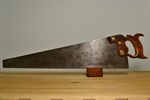
Richardson 23" 8 ppi rip saw (11-008-002) - $75 SOLD
This Richardson saw looks a little different than when it was first made. At 23 1/4" long, it was most likely cut down from a 24" saw. Somewhere along the line, the handle was replaced. The replacement handle is beech, and is of the appropriate size for a saw of these dimensions. It does have some notches and other battle scars, and I replaced the upper horn.
This saw is filed a little differently. Instead of being filed straight across (as most rip saws are filed), the teeth are filed with sloped gullets. This method used to be a little more common than it is nowadays, and is depicted in at least one sawmaker's catalog (Simonds). In practice, it seems to start and run a little easier. The speed of cutting and the cut surface is similar to that of a saw filed straight across. Because there is no fleam, the tops of the teeth are still perpendicular to the saw plate, and will not double as a crosscut saw.
The saw has been thoroughly cleaned and sharpened. The beech handle was removed, stripped, and refinished. As mentioned above, the upper horn was repaired. A previous owner added three notches along the top of the handle and three more on the blade itself. The saw nuts were lightly cleaned, and the blade sanded to remove any traces of rust and reduce friction. Although there is some very shallow pitting in a few areas, there is little at the toothline, and the cutting action is unaffected. The plate is straight. Finally, the teeth were reshaped, set, and sharpened. The only wood these teeth have seen is that used to ensure the saw runs clean and true. Suffice it to say, this saw is ready for action.
- Blade length - 23 1/4" at the toothline.
- Blade height - 6 3/8" at the heel, 1 1/2" at the toe.
- 8 ppi, filed rip (with sloping gullets).
- Teeth are filed with 0° of rake and about 15° sloped gullets. No fleam on this one.
- Very lightly breasted (a little under 1/16").
- Taper ground blade.


