Sharpening service for carbide Scrawls

With the recent acquisition of a new fixture for my grinder, I am now able to offer sharpening services for my carbide Scrawls.  If the point on yours has dulled or broken, it can be sharpened in the tool, so long as there is at least 3/4″ of carbide remaining.  Carbide points shorter than that will need to be replaced.

Sharpening services are also available for those of you who turned your own handle from one of my kits.  The only requirement for sharpening is that the diameter of the handle be less than 1″.

Carbide replacement is not available for kits.

Costs for sharpening and replacement are $0.25 (yes, just a quarter) and $9.25, respectively, plus shipping.

Posted in Announcements | Leave a comment

South Bend lathe milling attachment – Part I

I bought a South Bend Model A lathe late last summer.  It is a wonderful tool that has greatly increased my capabilities, allowing me to make, among other things, my own saw bolts/nuts and saw filing guides.

Although this lathe brought me one step closer to my goal of being able to make all of my own parts in-house, I still want to mill my own slots for the spines.  As much as I would love to own a Bridgeport or other full-sized mill, space and other constraints simply make that impossible at this time.

A few months ago, my friend and machinist mentor John brought up the idea of building a milling attachment for the South Bend lathe.  After much discussion, sketching, and research, we came up with what looks like a working idea.

The attachment shown in the SketchUp model below mounts permanently to the lathe bed.  The spindle is mounted on an old machinist vise for vertical/height adjustment, and uses the lathe carriage and cross feed for travel in the X and Y directions.  It will have 18 inches of travel in the X direction, allowing me to mill spines for saws up to 18 inches long.

The spindle will be driven by a variable speed DC motor mounted behind the lathe.  Power is transmitted by a flat leather belt.

Now all that remains is to turn this idea into a working reality.  With a little luck, it will work out as hoped and planned.  If I fall flat on my face with this, then  back to the drawing board I go…

Front view of milling attachment.

Front view of milling attachment.

Side view of milling attachment.

Side view of milling attachment.


Posted in SB lathe milling attachment, Toolmaking | Leave a comment

Where wood comes from…

Yes I know it grows on trees, but the transformation of trees into usable lumber has fascinated me for some time now.

One of my favorite garage sale finds is a Stihl 025 chainsaw, which has been an invaluable aid in harvesting timber and processing it in my backyard.  Admittedly, the wood I cut is not large enough for many projects, but it is an excellent source for woods that are just not available from a sawmill.  With careful cutting, the wood can be of the highest quality – precisely quartersawn to a degree that is just not feasible with large logs on a mill.
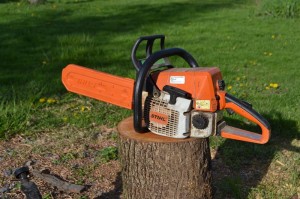
Stihl 025 chainsaw

One of my favorite tools – a Stihl 025 chainsaw.

The colors and vibrancy of freshly cut wood can be indescribable.  The water in the wood gives it life, moreso than any other finish I have ever seen.  Although the freshly cut colors will mellow and change, the fleeting glimpse is enough to keep me looking forward to working the wood when it is finally dried.

Most of the wood comes from trees that have fallen across or near a road or that have been removed from yards.  Recent finds have included enough beech for several sets of hollows and rounds, sycamore, apple, and most recently a wood that the homeowner called miniature pear.  This latter wood is destined mainly for saw handles, should it prove suitable for that use.

I don’t know whether or not this wood is actually a fruitwood, but it looks promising.  The freshly cut wood is a creamy white, with very little visible grain.  Some (but not all) of the exposed wood turns a yellowish-orange color, so I’m not sure what the dried wood will look like.  To say I am looking forward to seeing how it turns out is an understatement.  While I wait, I will send a sample of the wood to the USDA Forest Products Laboratory for identification, a free service for US citizens.

This log is typical of what I look for.  It’s small enough that I can lift it into my trunk, yet large enough to yield several saw handles.  With no visible knots or defects to work around, this log may give me a half dozen handle blanks, with the balance being used for handles on other tools.

When possible, I prefer to use quartersawn wood for my saw handles.  On logs this small, careful layout is needed to ensure the blanks are large enough.  The first cut follows the pith of the log, and is made perpendicular to the largest dimension of the log (the pith is not centered on this log).  The next cuts are perpendicular to the first, and give me three pieces that are large enough for handles.

Laying out the first cut on the miniature pear log

First cut is through the pith, but perpendicular to this scale.

Laying out the cuts for the saw handle blanks.

Laying out the next four cuts.  With any luck, these three boards will be used for saw handles.
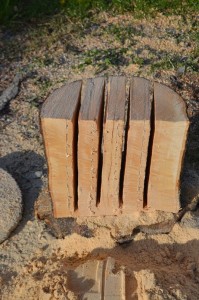
Cutting out the middle three boards

Three boards, ready to break apart. Don’t cut all the way through, or the pieces become too small to cut safely.
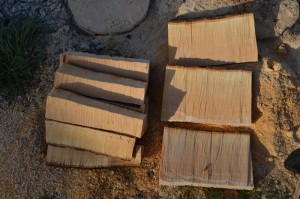
Three boards, ready to dry

Three boards for saw handles, and the balance for other tool handles.

After sealing the ends with AnchorSeal and finding a suitable location for drying, the only thing left to do is wait.  Stop back in several months for an update…

Posted in Toolmaking, Wood | Leave a comment

Gyotaku, saw version

When you have a simple mind, you are easily amused by little things.  While sanding the handle for a dovetail saw, I saw this graceful outline of the handle appear in the sawdust.  Perhaps this art form will someday become the woodworker’s version of Gyotaku.

Ten inch DT saw in sawdust

Ten inch DT saw in walnut sawdust.

Posted in Visual pleasures | Leave a comment

Website updates

I apologize to those of you who were unable to access my website last night and this morning.  I rewrote some of the code, which necessitated reloading the entire site, a process that took longer than I anticipated.

When I took this website public about a year ago, it was intended mainly as a means of selling off some of the old woodworking tools I had accumulated over the years.  Over the last year, the focus has gradually shifted to my new tool business.  This has necessitated numerous changes to the website, most of which were additions to the content and improvements in layout and navigation.

The most recent update included the addition of photo galleries to my saw description pages, as well as the debut of this blog.  There is also a new page for saws that are ready to ship immediately.  These are limited in number, but can be a good way to get one quickly.

If you come across any typographical or factual errors, broken links, or other errors, please drop me a note.  I do my best to proofread everything, but mistakes always seem to slip through.

Posted in Announcements | Leave a comment