Woodworking in America (WIA) 2013 Marketplace

I have always wanted to attend a Popular Woodworking’s WIA Conference, but never thought it would be as a vendor.

I am very excited about this event.  It will be a great chance to let customers try out my tools and meet other tool makers.

If you attend, please stop by, say hello, and try out a few saws.

Posted in Shows | Leave a comment

RakeMaker II build along – handle

This is the first part in a series that will chronicle how I make a RakeMaker II.

Handle making begins with stock selection – dry, straight grained apple, cherry, and walnut.  Since only small pieces are needed, I am able to use bits and pieces, drops from other projects.  The handle in the following pictures is made of apple.

I begin with square stock that is about six inches long, which will yield three handles if I don’t make any mistakes.  I use three measurements to define the shape:  the largest diameter, the overall length, and the diameter at the base of the handle.

Handle blanks.

Handle blanks.

Squared up and ready to start turning.

Squared up and ready to start turning.

Roughing the blank.

Roughing the blank.

Maximum diameter and overall length marked on the blank.

Maximum diameter and overall length marked on the blank.


I use the three tools shown below to turn the handles.  I am not really a woodturner, so take what you see below with a grain of salt.  I have learned a couple of things along the way, though.

  • Sharp, light cuts work best for me, especially in dry wood that is unsupported at one end.
  • Profiles are easiest to reproduce when the shape mirrors that of the tools used for turning.
The three tools I use.

The three tools I use.

Rounding over the end.

Rounding over the end.

Turning the base to its diameter.

Turning the base to its diameter.

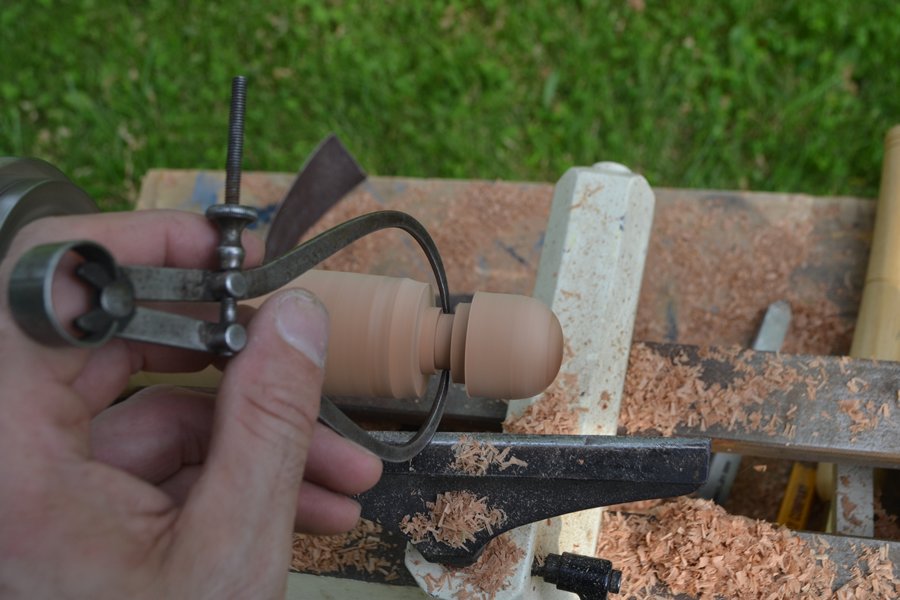
Measuring the diameter of the base.

Measuring the diameter of the base.

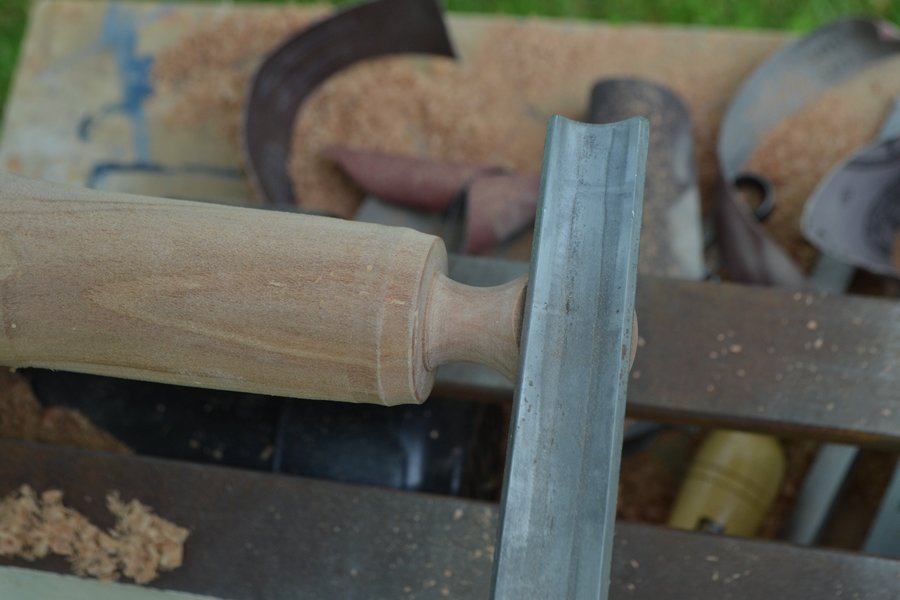
Turning the profile at the base of the handle.  Notice how the profile of the tool matches the handle.

Turning the profile at the base of the handle. Notice how the profile of the tool matches the handle.

Finishing up the profile.

Finishing up the profile.

The roughed out handle, ready for sanding.

The roughed out handle, ready for sanding.

After sanding the handle I turn the grooves.

After sanding the handle I turn the grooves.


After the lathe work is done, the finger grips need to be shaped.  Any half round file or rasp will work, but I use milled tooth or Vixen files.  they cut fast and leave a clean surface.  I have also used a Liogier rasp for this task, and with great success.

Shaping the finger grip.

Shaping the finger grip.

I use an Iwasaki milled tooth file to shape the finger grip.

I use an Iwasaki milled tooth file to shape the finger grip.

Finger grips shaped.

Finger grips shaped.

Drilling a thru hole for mounting the handle to the body.

Drilling a thru hole for mounting the handle to the body.

Parting the handle off.  I undercut the base slightly so that it will fit tightly to the body.

Parting the handle off. I undercut the base slightly so that it will fit tightly to the body.

I finish removing the handle with a saw.  I've had bad luck trying to part it off all of the way with the chisel.

I finish removing the handle with a saw. I’ve had bad luck trying to part it off all of the way with the chisel.

Just a little cleanup needed after cutting the handle off.

Just a little cleanup needed after cutting the handle off.


Turning the handle, as hard as it may be to believe, is the single most time-consuming part of this saw filing guide.  But it is very comfortable in the hand, and I think it looks pretty good on the tool.

The completed handle, ready for finish.

The completed handle, ready for finish.

Posted in Toolmaking | 3 Comments

South Bend lathe milling attachment – Part VIII

Surfacing the mill bed and test run

With the bed attached to the cross slide and the motor wired hooked up, I could finally start running it.  The first task was to true the bed, which was a simple (but time-consuming) matter.

Using a fly cutter, I was able to remove about 0.006″ with each pass – certainly not hogging material off, but the end results were hard to fault.  There was no perceptible ridge between any of the passes, an indication that the head is indeed perpendicular to the lathe ways.

Using a fly cutter to true the milling bed surface.

Using a fly cutter to true the milling bed surface.

The finished surface.

The finished surface.


With the milling bed surfaced, it was almost time to try slotting a spine.  First I needed to make a fixture to hold the spine.  The fixture is made with three pieces of metal that are bolted to the milling bed; the spine is held in a groove with several set screws.

Fly cutting the spine slotting fixture base.  This ensures that the spine is held parallel to the table so that the slot in the spine is, in turn, parallel to the sides of the spine.

Fly cutting the spine slotting fixture base. This ensures that the spine is held parallel to the table so that the slot in the spine is, in turn, parallel to the sides of the spine.

Slotting the first saw spine.

Slotting the first saw spine.


The results were better than I had dared hoped for.  While slotting the spines is a time-consuming process, they turned out beautifully.  The slots are perfectly centered and run true for the entire length of the spine.  Best of all, this attachment finally gives me the capability of moving the entire production of the saw into my own shop.

Posted in SB lathe milling attachment | 4 Comments

South Bend lathe milling attachment – Part VII

The motor

To power the milling attachment, I bought a 1725 rpm 1/4 hp DC motor on eBay.  My brother sent me a DC drive unit for the motor, which gives me the luxury of variable speed (from about 35 to 2000 rpm) and reversible rotation.

Face-mounted DC motor.

Face-mounted DC motor.


I decided to mount the motor behind the milling attachment.  This simplified construction and reduced the weight of the attachment (there is some concern that the weight of the attachment will distort the lathe bed).  By mounting the motor on a shelf behind the lathe, I also gained some valuable real estate for tool storage.

The motor will transmit power to the milling head with a flat leather belt.  Using a flat belt will allow the motor to remain stationary while the milling head travels up or down (the belt is free to traverse the length of the milling head pulley).

Construction of the shelf was straightforward.  Sadly, building this shelf was the most woodworking I have done in many months.  I used 5/4 poplar, and simply dadoed the sides and screwed the shelves to them.  Fine woodworking it isn’t; sturdy it is.

All parts surface planed, sides rabbeted.

All parts surface planed, sides rabbeted.

Preparing to dado the sides.  Begin by setting the depth stops on the miter box so that the teeth just touch the top of the board.

Preparing to dado the sides. Begin by setting the depth stops on the miter box so that the teeth just touch the top of the board.

Remove the board and place two shims on the bed.  The depth of the dadoes will be equal to the thickness of the shims.

Remove the board and place two shims on the bed. The depth of the dadoes will be equal to the thickness of the shims.

Place the board on top of the shims and saw the shoulders of the dado until the saw bottoms out on the depth stops.

Place the board on top of the shims and saw the shoulders of the dado until the saw bottoms out on the depth stops.

This is the finish that a well-sharpened miter saw is capable of delivering.

This is the finish that a well-sharpened miter saw is capable of delivering.

Remove the bulk of the waste with a chisel.

Remove the bulk of the waste with a chisel.

Finish the dado with a router plane.

Finish the dado with a router plane.

Assembled, save for the plywood back.

Assembled, save for the plywood back.

Drilling the holes for mounting the motor.  I used an expansive bit to drill the hole for the motor shaft.

Drilling the holes for mounting the motor. I used an expansive bit to drill the hole for the motor shaft.


The back of the shelf unit is 1/4″ plywood, and is nailed to the sides and shelves.  It is attacked to the bench top with wood cleats.

Shelf completed and attached to the bench top.  The belt is installed, the DC drive unit hooked up, and it is ready to test.

Shelf completed and attached to the bench top. The belt is installed, the DC drive unit hooked up, and it is ready to test.

Posted in SB lathe milling attachment | Leave a comment

Saw bolt repair

When a customer ordered some new saw bolts for a saw he was restoring, he asked if there was anything that could be done about the medallion.  I agreed to take a look at it and see if I could salvage it.

A quick glance confirmed that it would indeed need a new shank.  The threads were long gone, and what was left behind was bent.  With little to lose, I cut the existing shaft off and started anew.

Shank cut off.

Shank cut off.


The shank was turned from 360 brass.  The squared portion of the shank was filed by hand, and was made larger than the original so that it would fit in the existing mortise, even if damaged.

New shank.

New shank.


The back of the medallion needed some work as well.  The first step was to true up the mating surface.  To provide more surface area for the solder, and to make it easier to align while soldering, I milled a shallow recess in the back of the medallion.

Truing up back of medallion.

Truing up back of medallion.

Milling recess for new shank.

Milling recess for new shank.


With the medallion ready, the shank could be finished.  After turning the shoulder, I milled the end of the shank with a slight concave profile.  This was done so that it would mate with the convex surface left by the end mill at the bottom of the recess.

Milling back of medallion.  End mill is slightly concave.

Milling back of medallion. End mill is slightly concave.

Shoulder milled on end of shank; milling the end concave.

Shoulder milled on end of shank; milling the end concave.

Medallion and shank ready for assembly.

Medallion and shank ready for assembly.


The actual soldering was the easiest part of the job, taking about fifteen seconds. I used silver bearing solder, which, while not as strong as brazing or silver solder (which has a higher percentage of silver in it), is sufficiently strong for this purpose.

Ready for soldering.

Ready for soldering.

Soldering done.

Soldering done.


After removing the excess solder and lightly cleaning the surface of the medallion, it is ready to go back on the saw for the next hundred years.

Back view after cleaning up the solder.

Back view after cleaning up the solder.

Ready for the next hundred years.

Ready for the next hundred years.

saw-bolt-repair-11

Well worth the time and effort to be able to put this back on the saw.

Posted in Saw repair | 2 Comments

South Bend lathe milling attachment – Part VI

The milling table

The milling table will mount to an extra cross slide that I picked up on eBay.  The table will bolt to the cross slide, and left there permanently.  It takes less than a minute to switch between the cross slide that is used for lathe work and the one used for milling.

Because the column sits just a few inches behind the ways, the tail end of the cross slide needs to be chopped off for clearance.  This tail end of the cross slide has no structural purpose, but serves only to keep swarf off of the cross slide screw.  I cut the tail off by hand with a hacksaw, and used a belt sander to smooth out the cut.

Marking cross slide for cutting.

Marking cross slide for cutting.

Cross slide cut and cleaned up.

Cross slide cut and cleaned up.


Before mounting the table to the cross slide, the I trammed the head to the cross slide (tramming is the process ordeal of adjusting the head to be perpendicular to a reference surface in all directions).

Not being a machinist by trade, and not having a full arsenal of indicators at my disposal, I used the setup shown below.  It sweeps a 3″ diameter circle.

Indicator setup.

Indicator setup.


Adjustment of the head is made in two planes.  The first is from front to back, and is made with a screw that bears against the bottom of the front rail.  Advancing the screw tilts the head downward and forward.

Adjustment screw for tramming the head.

Adjustment screw for tramming the head.


The second adjustment is made at 90 degrees to the first, and is achieved by rotating the mounting vise.  This is done by loosening the mounting screw and rotating the vise.

Mounting/adjustment bolt for the vise and milling head.

Mounting/adjustment bolt for the vise and milling head.


Tramming the head took the better part of the morning, but I was able to get it within about +/-0.0005″ over the range of travel.  The table is now mounted to the cross slide.  After the motor is in place, the table will be milled in place to give a true surface.

Milling table attached to cross slide.

Milling table attached to cross slide.

Posted in SB lathe milling attachment, Toolmaking | 2 Comments

South Bend lathe milling attachment – Part V

Mill column fabrication

While the milling head was the most involved part of the build, the column was also time-consuming.  Lots of drilling and tapping, as well as some machining, can really eat up some time.

Mill column parts.

Mill column parts.


I think everything here is fairly straightforward.  The milled surface on the front top of the column is where the vise will be mounted.  There is a bronze sleeve in the hole the the lug on the vise fits into.  Although I don’t plan on rotating the vise often, I would prefer to minimize steel to aluminum contact, especially when those parts are moving.

Front view of assembled column.

Front view of assembled column.

Rear view of assembled column.

Rear view of assembled column.


The column is held against the underside of the bed by two bolts that pass through a clamping bar.  As the bolts are tightened, the clamping bar wedges between the webs that connect the two ways.  It makes for a very rigid connection, and requires no drilling into or modification of the lathe.  The clamping bar  sits low enough that the tailstock can pass over it.

Clamping bar.

Clamping bar.

Column in place, with milling head and vise attached.

Column in place, with milling head and vise attached.


Posted in SB lathe milling attachment, Toolmaking | Leave a comment

South Bend lathe milling attachment – Part IV

Milling head/spindle completed

The milling head is assembled and ready to be attached to the column.  The pictures below show the parts.  Just the frame, a collet holder, the pulley, and two bearings.  The bearings are just radial ball bearings.  I thought about using angular contact bearings, but the local bearing supplier recommended these ones.  Since the intended use will not exert any axial forces, I hope they will be sufficient.  If not, I will replace them with more suitable ones.

Milling head components.

Milling head components.

Milling head, assembled.

Milling head, assembled.

Milling head, assembled - bottom view.

Milling head, assembled – bottom view.


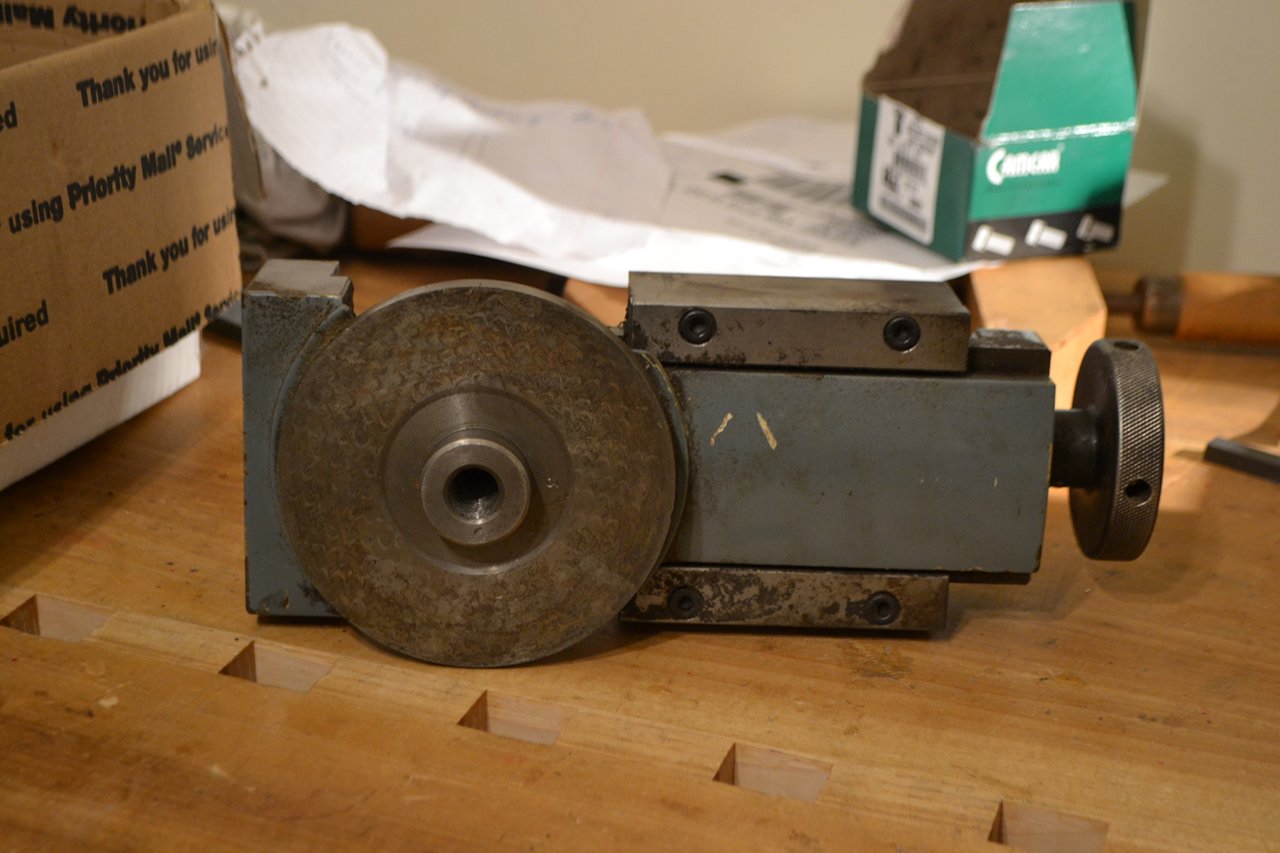
And this is the vise that the milling head will be mounted to.  I have no idea what it was originally used for, but it is extremely well made to close tolerances.

Top view of vise.  The milling head will be attached to the moving jaw (the large flat surface on the right).

Top view of vise. The milling head will be attached to the moving jaw (the large flat surface on the right).

Bottom view of the vise.  The boss fits into a hole on the column.

Bottom view of the vise. The boss fits into a hole on the column.


Posted in SB lathe milling attachment, Toolmaking | Leave a comment

South Bend lathe milling attachment – Part III

Milling head/spindle fabrication

The most challenging part of this build is the spindle assembly.  Not only does it need to run true, it needs to have a means of vertical or height adjustment.  The first concern is easily addressed by careful layout and machining.  I went through multiple designs to address the second requirement, with each successive iteration becoming more expensive, costly, and time-consuming to build.

About two months ago, I found a neat solution to the adjustment problem at a local machinery auction.  A vise, from some long-forgotten machine, provided about three inches of travel, a nice mounting surface for the milling head, and tank-like construction.  A precision tank, no less – there is no perceptible play in it, and backlash of the handle is just a few degrees.

The spindle is a 6″ long ER20 collet chuck.  The shaft has a diameter of 20 mm, and runs in a C-shaped mounting block with bearings at each end.  In between is a 4 1/4″ diameter flat pulley machined from a piece of solid aluminum.  The wide pulley allows vertical travel of the head while the motor remains stationary.

Milling the back and mating surfaces of the milling head.

Milling the back and mating surfaces of the milling head.

Milling head components milled and ready for assembly.

Milling head components milled and ready for assembly.


After assembling the C-shaped mounting block, we needed to bore holes in each end for the bearings.  Since it is critical that these holes be co-axial, we line bored them from a single setup.  This was, I hope, the most complex and time-consuming part of the build.

Indicating the head so that the spindle will be parallel to the back.
Indicating the head so that the spindle will be parallel to the back.

Boring the top bearing housing.

Testing the top bearing housing for fit.
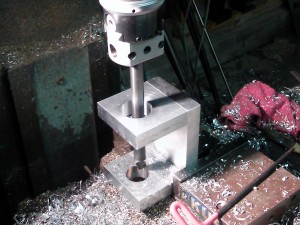
Boring the bottom bearing housing.

Boring the bottom bearing housing.


The pulley is straightforward.  Since the flat belt must travel up and down on it when the head is moved, there is no crown.  I used bronze bearings at both ends of the pulley to avoid an aluminum to steel interface that would make removal difficult.  I bored the hole a few thousandths smaller than the flanged bronze bushings, then pressed them in.  The ID of the bearings was slightly oversized to begin with, but the press fit compressed them enough to give a perfect slip fit.  I still need to drill and tap the pulley for set screws to secure it on the shaft.

Boring the pulley for the shaft and bronze bearings.
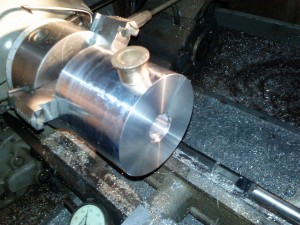
Boring the pulley for the shaft and bronze bearings.

Pulley and bearings ready to assemble.

Pulley and bearings ready to assemble.

Assembled pulley and bearings.

Assembled pulley and bearings.


While the aesthetics leave a little to be desired, time is in short supply for this project. I would dearly love to machine every surface, but for now we are concentrating only on mating and reference surfaces.  Everything else will just be sanded or filed by hand to clean it up.  In the end, this is a working machine and there is no shame in a little roughness around the edges.

Posted in SB lathe milling attachment, Toolmaking | Leave a comment

South Bend lathe milling attachment – Part II

Cutting out the components

After months of thinking about it, there was no more putting it off.  I was able to get all of the parts for the frame out of these two pieces of 1×4 aluminum that my friend John gave me.

All of the cuts were made with a circular saw.  It worked well enough, but I wouldn’t want to do it day in and day out.

The raw stock - 1x4 6061 aluminum.

The raw stock – 1×4 6061 aluminum.

Laying out the cuts.

Laying out the cuts.

All of the aouminum components, ready to mill.

All of the aluminum components, ready to mill.


It doesn’t look like much yet, but at least it is started.

Posted in SB lathe milling attachment, Toolmaking | Leave a comment