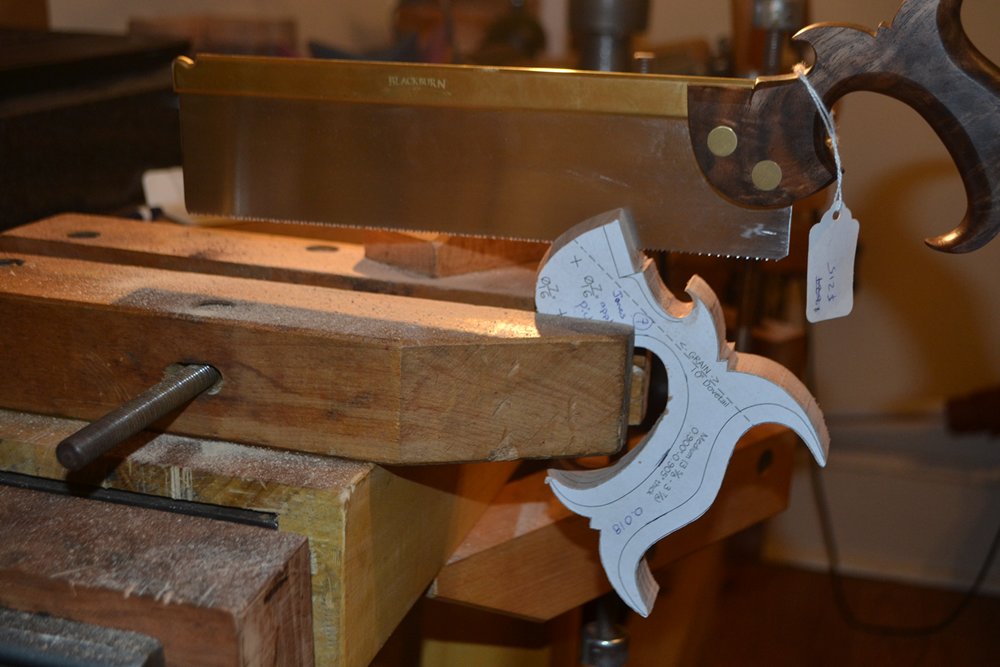
Saw build along – Handle, Part IV

This is the fifth entry in a nineteen part series that covers the construction of one of my saws from start to finish. For links to the other entries, please see the full chronological index.  -Ed.

Cleaning up the nibs, beak, and horns

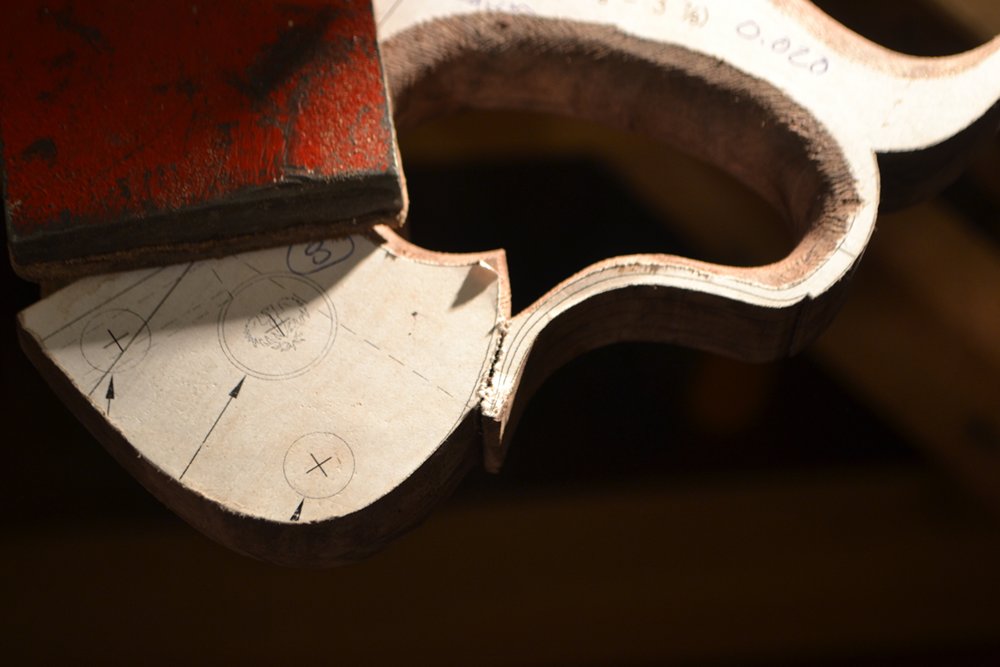
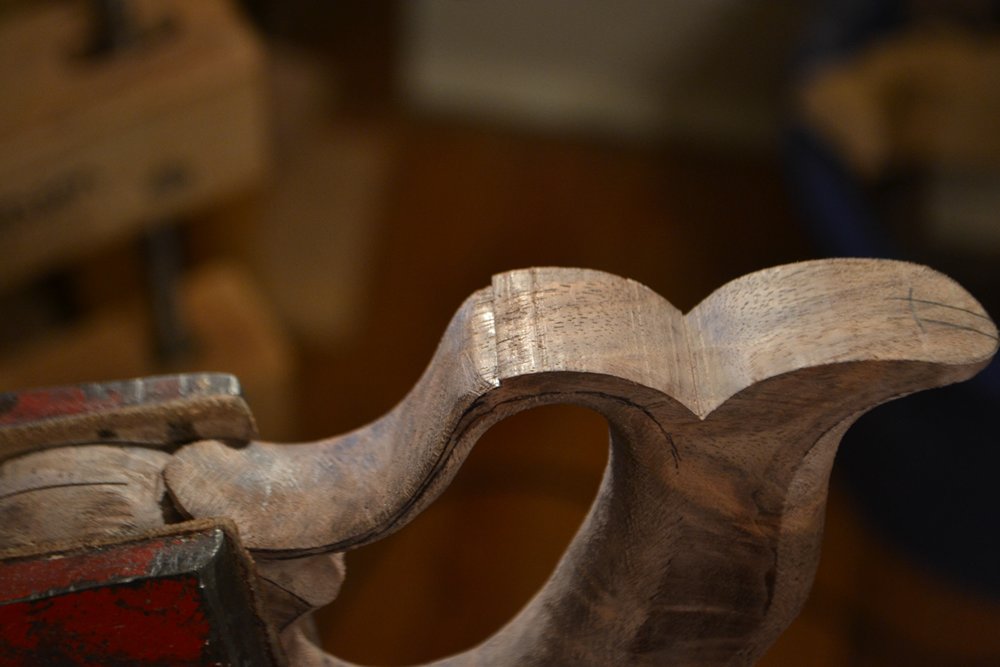
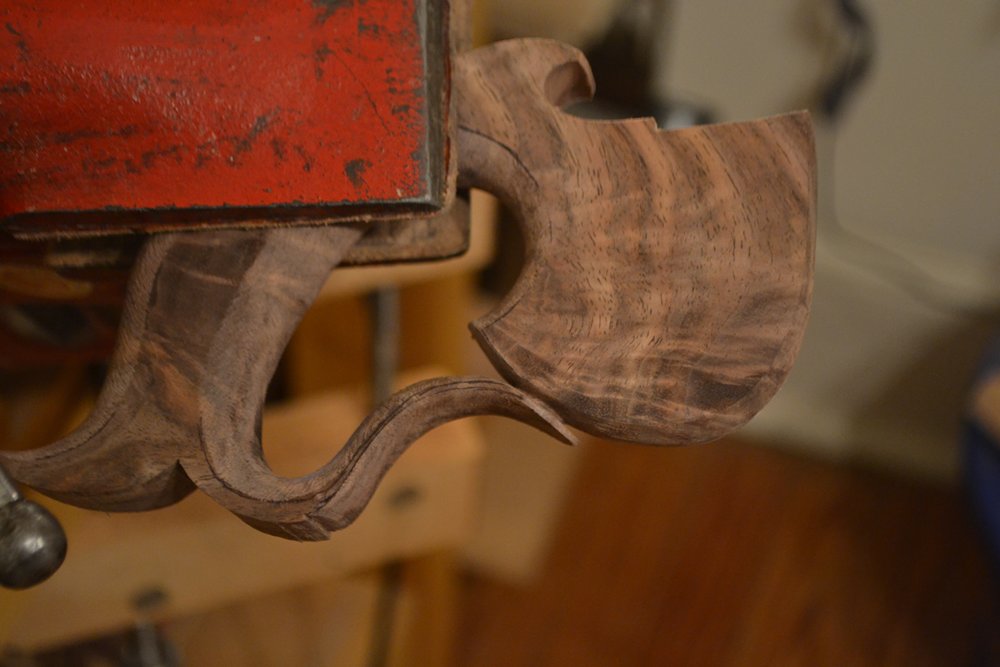
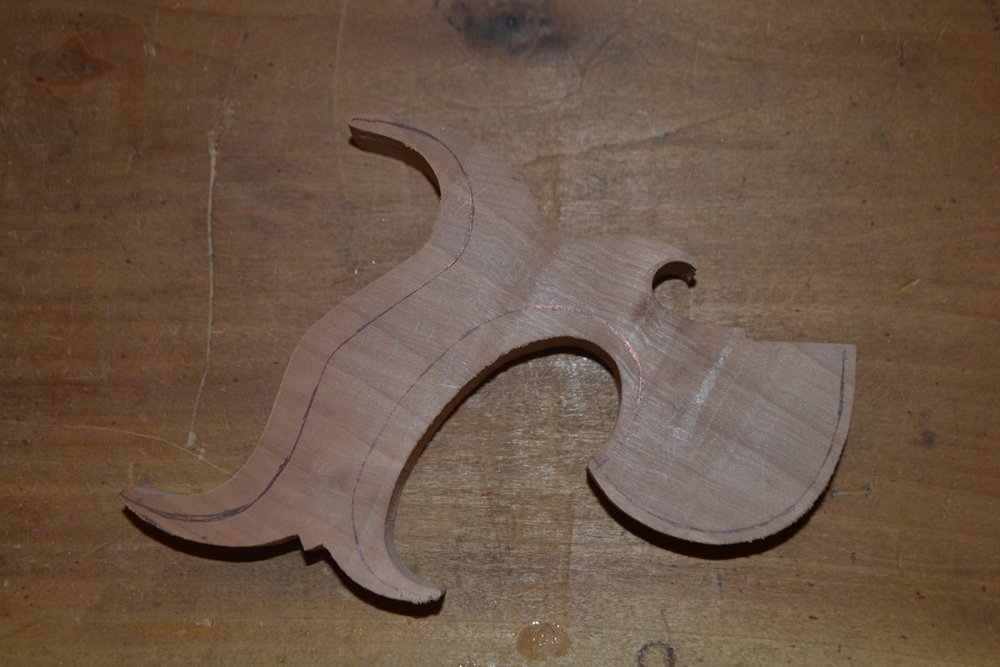
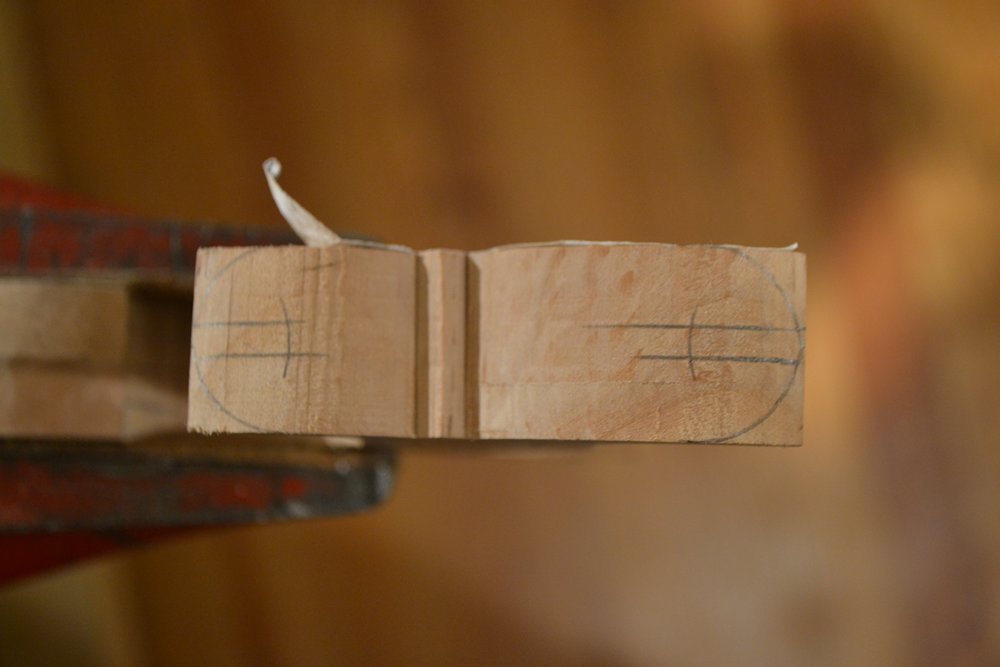
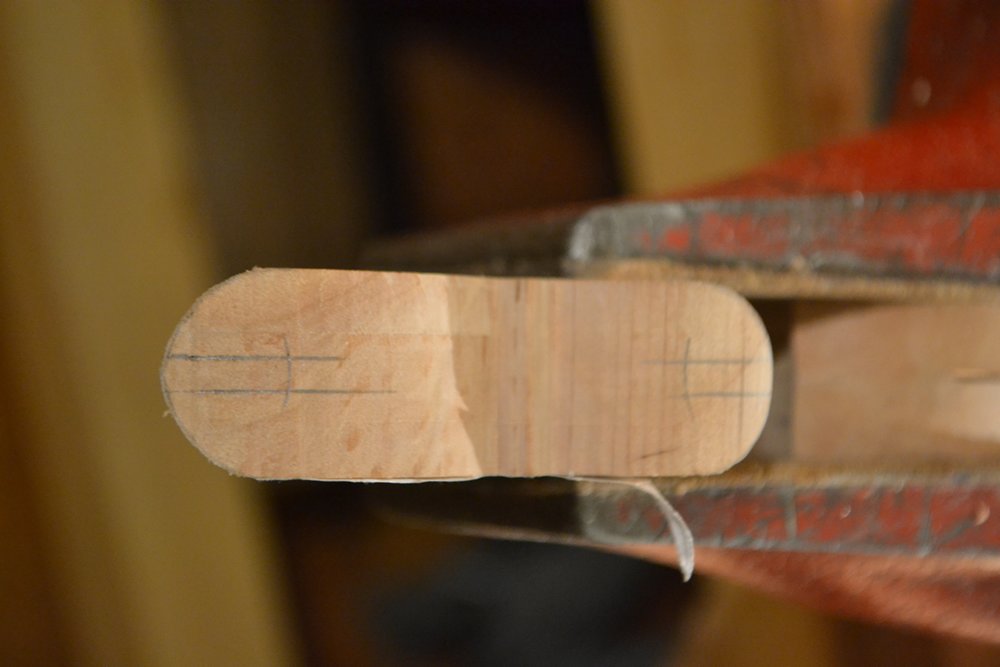
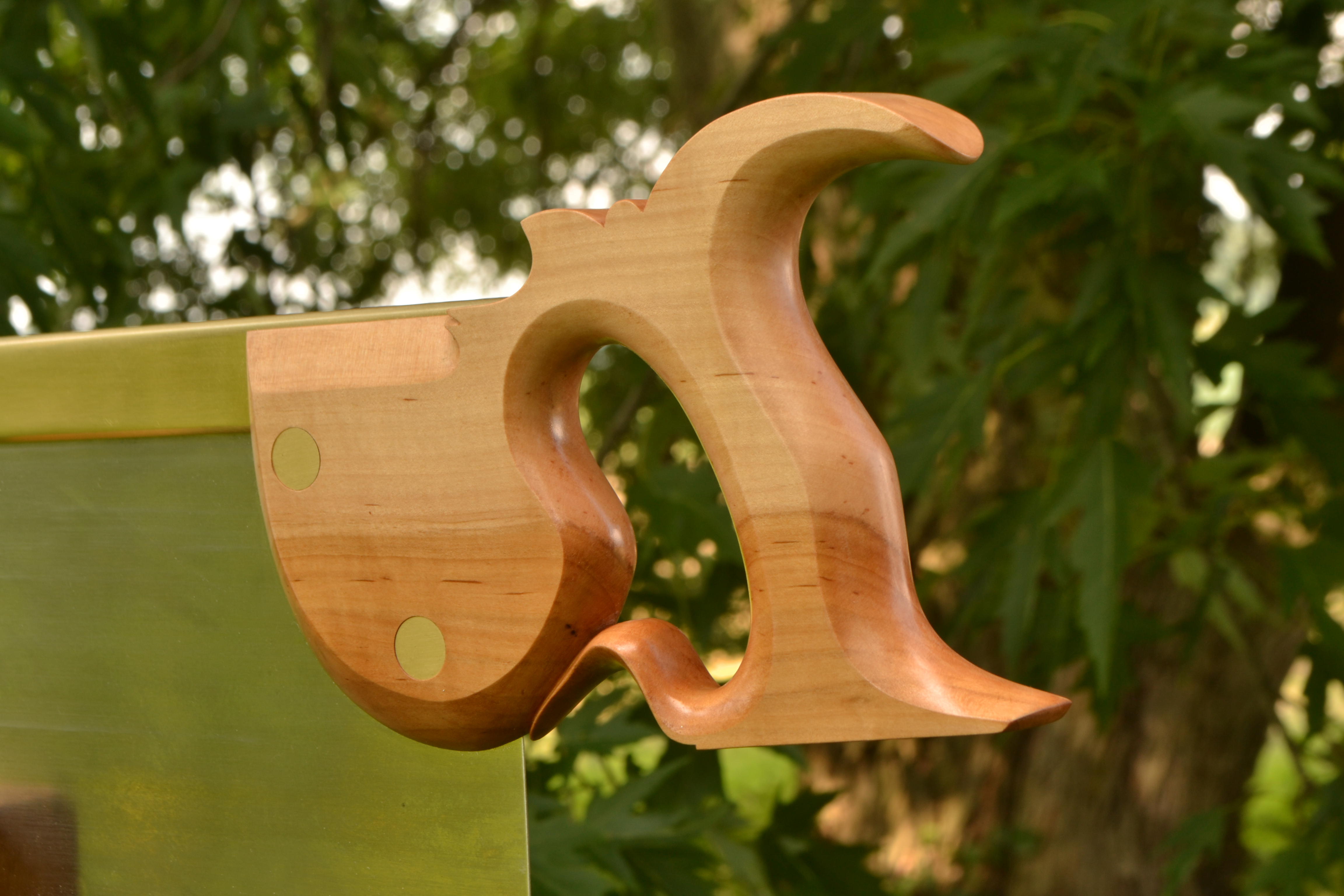
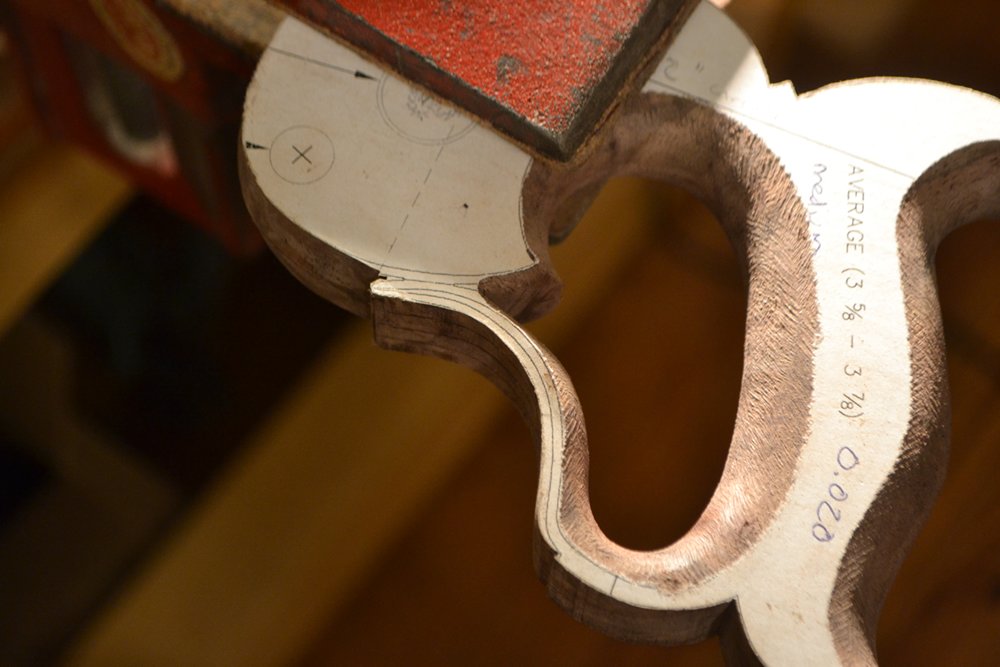
While the scroll saw is an efficient method of cutting out handle blanks, the surface left behind requires some refinement. I do this work with a chisel, a Vixen file, and sandpaper.
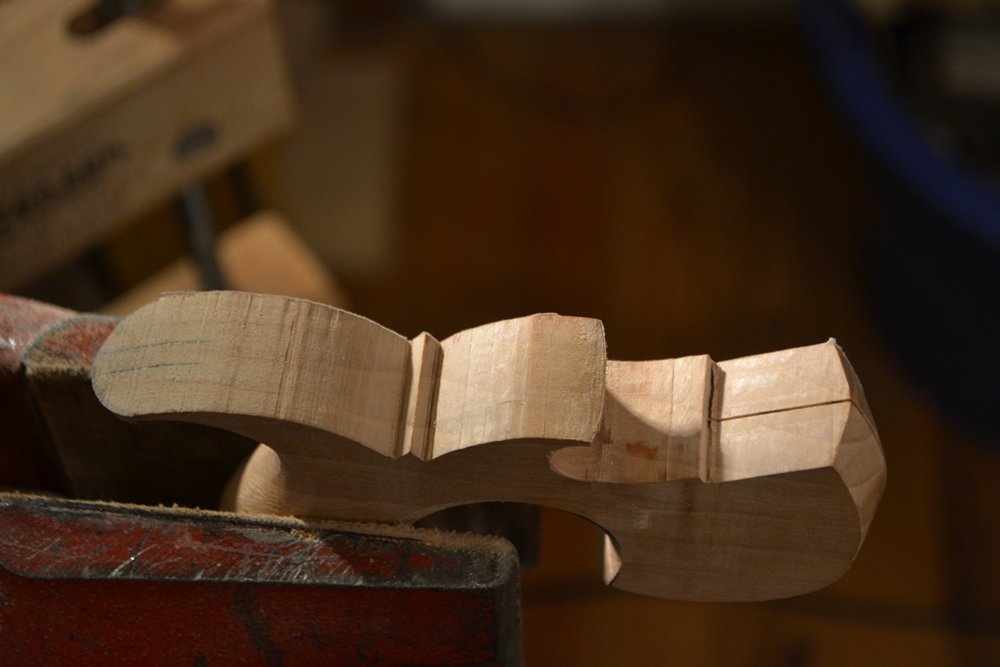
The surface left from the scroll saw.

The surface left from the scroll saw.


I begin by cleaning up the nibs with a sharp chisel.  This work requires a sharp chisel and careful attention to the direction of the cut.  Since the tips of the nibs are end grain, they crumble and chip easily.  Some woods will take a fine detail, and their tips can be left relatively sharp.  Woods like apple, beech, and cherry fall into this category.  Other woods, such as walnut, do not play so nicely and require more rounding over (which I do with sandpaper).
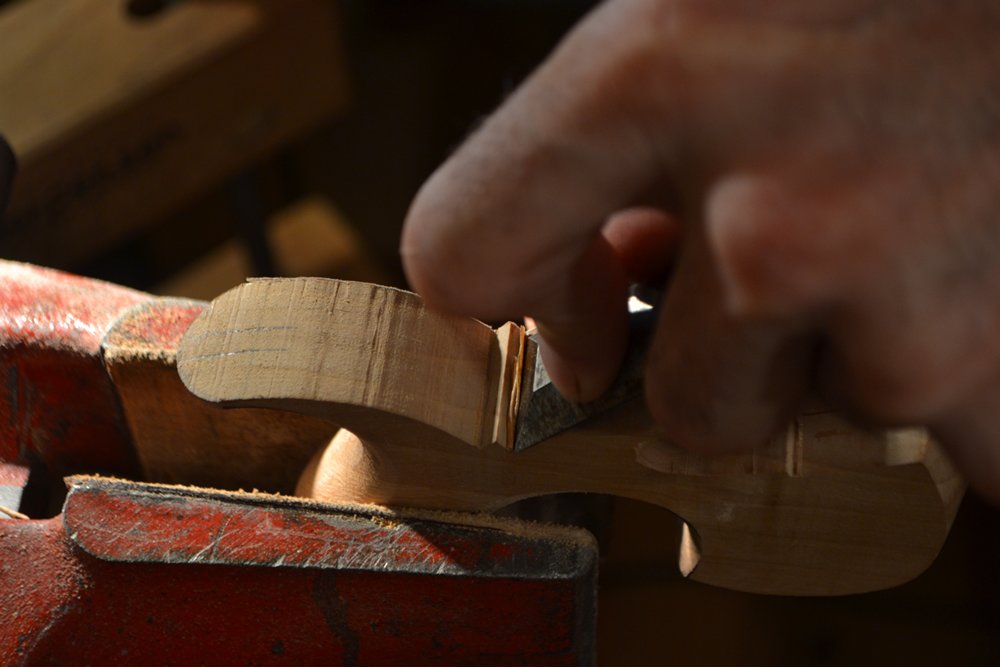
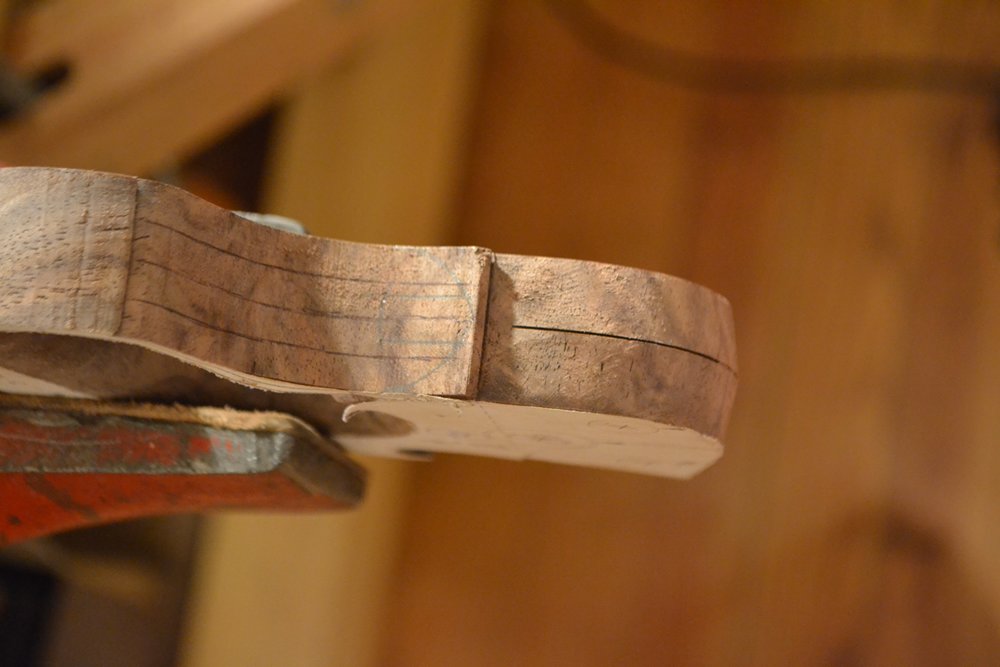
Begin by paring the 1/8" immediately fore and aft of the nib.

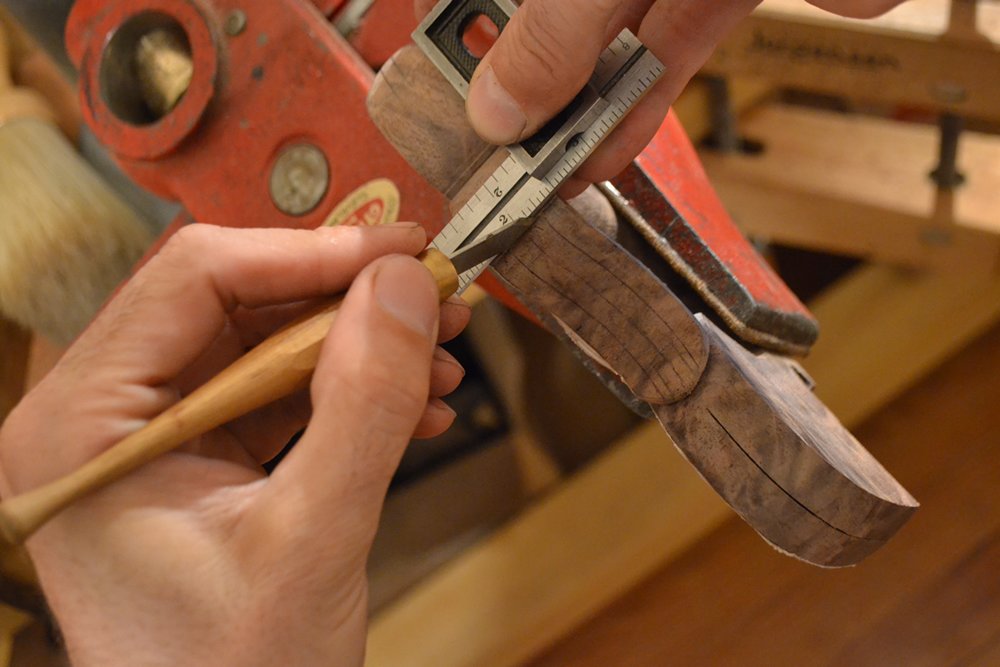
Begin by paring the 1/8″ immediately fore and aft of the nib.
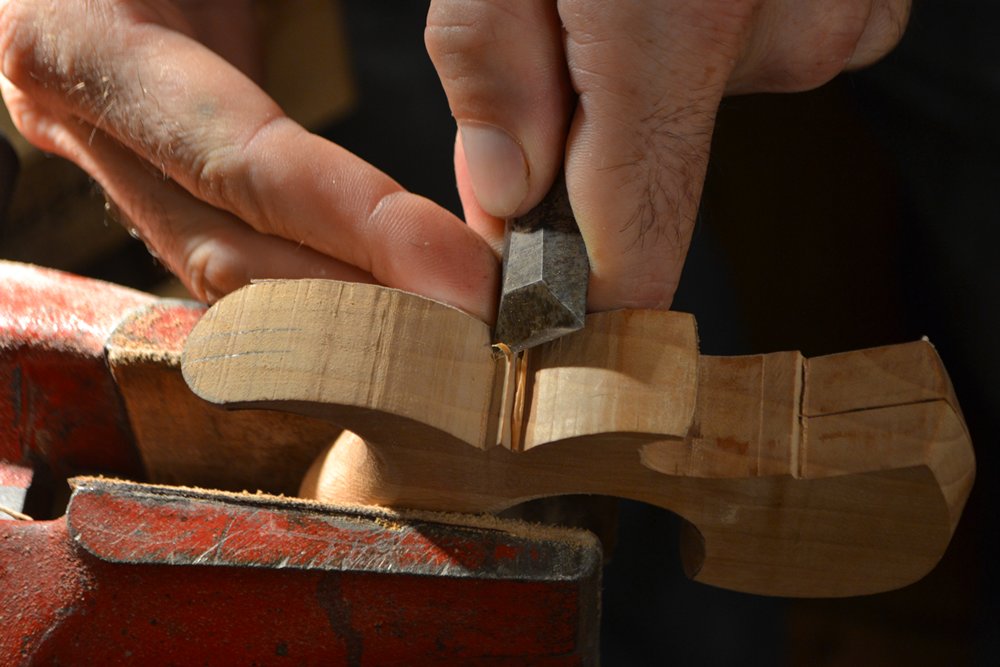
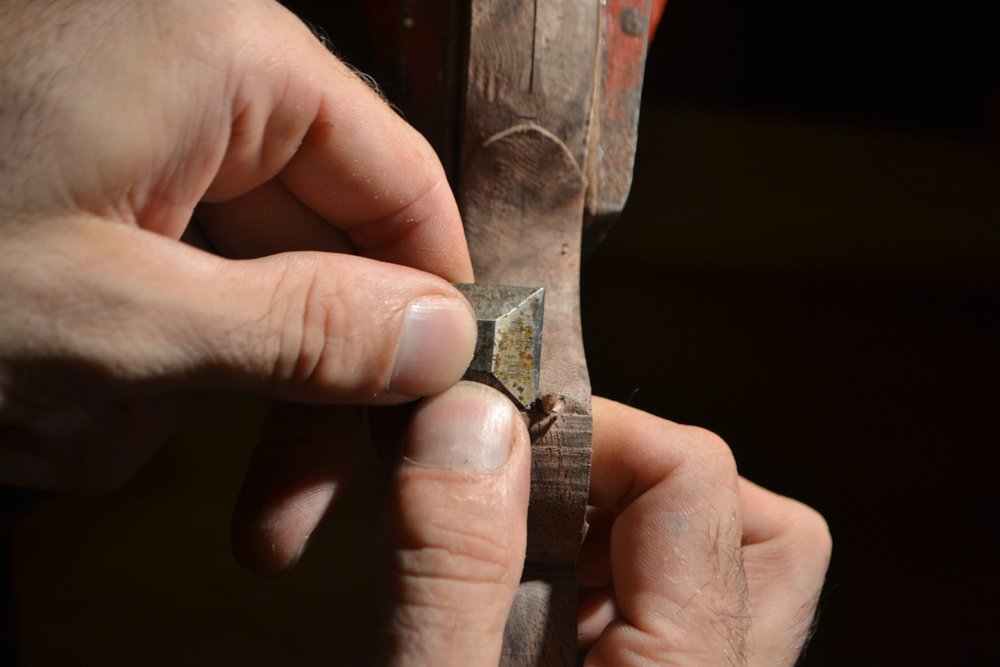
Pare the nibs - I begin by cutting across the grain...

Pare the nibs – I begin by cutting across the grain…
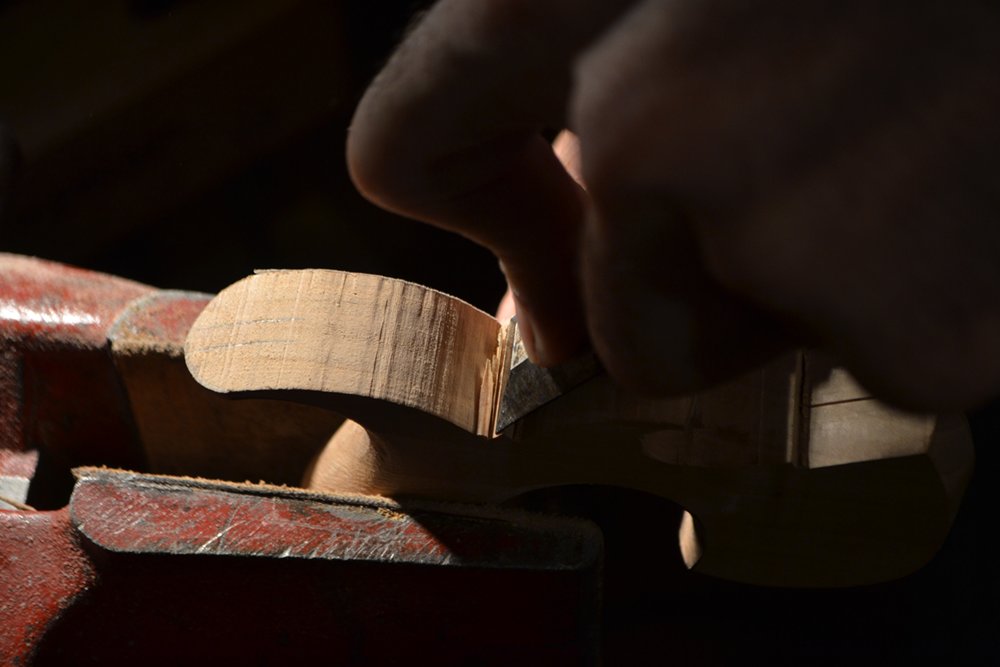
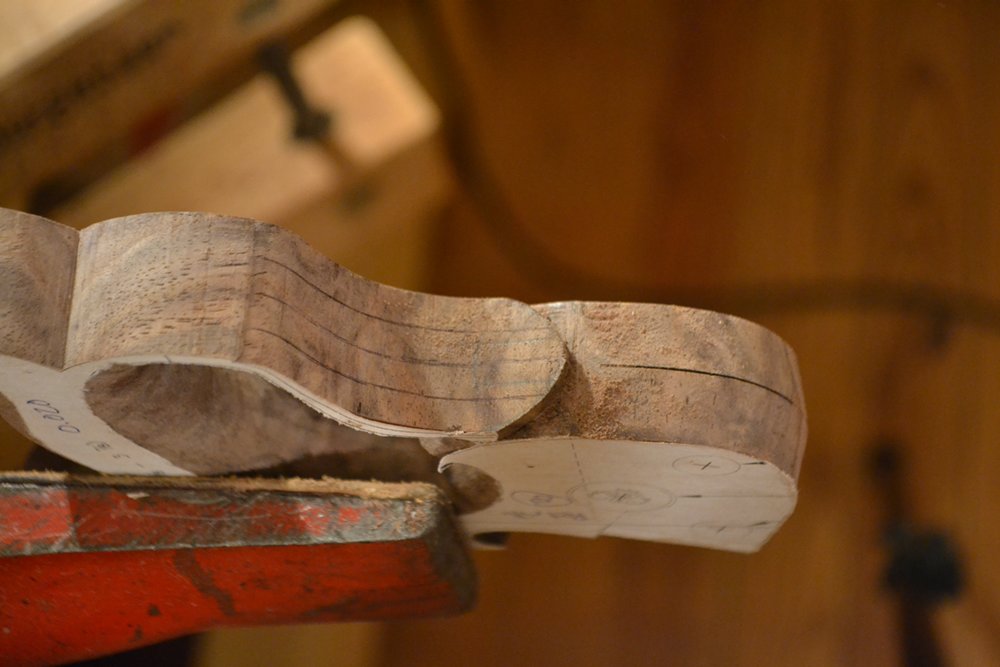
...and then finish it off by paring with the grain so that the surface of the nib is a single facet.

…and then finish by paring with the grain so that the surface of the nib is a single facet.


While this is a fairly easy task (particularly if the blank was cut out well), be certain to keep an eye on the nib to ensure that it is properly formed.  Ideally, each facet should be perpendicular to the sides of the handle and of the same length.  Perpendicularity can be checked with a square, or by sight.  The small facets make any deviation readily apparent.

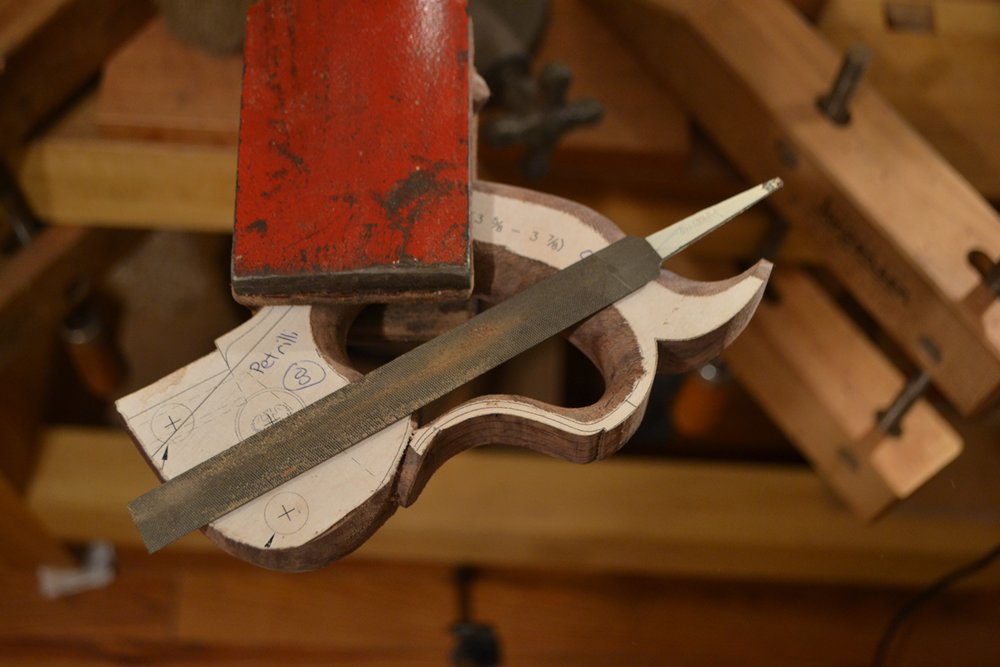
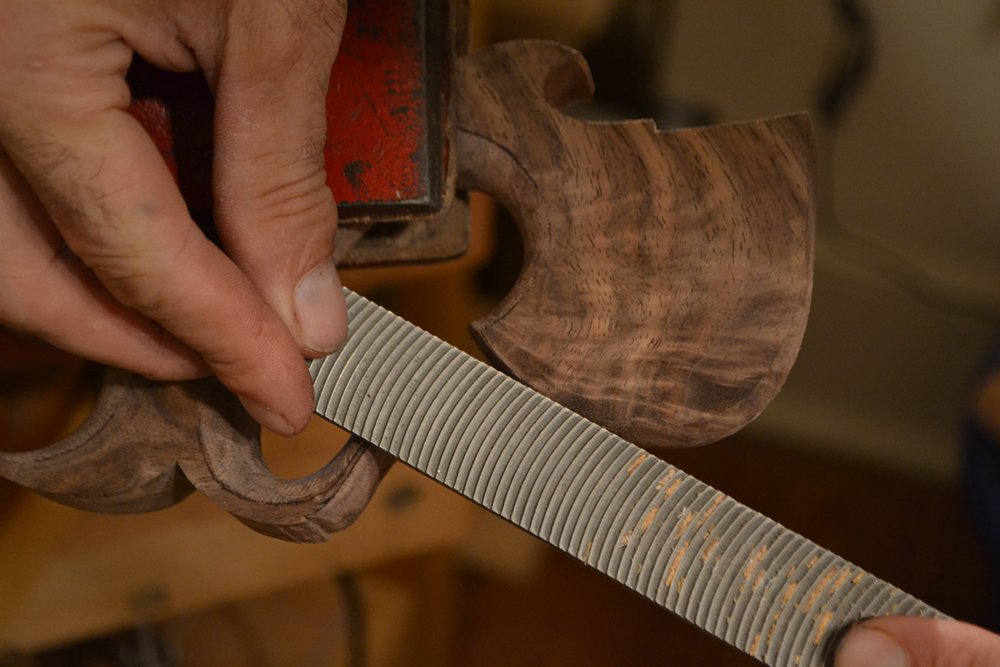
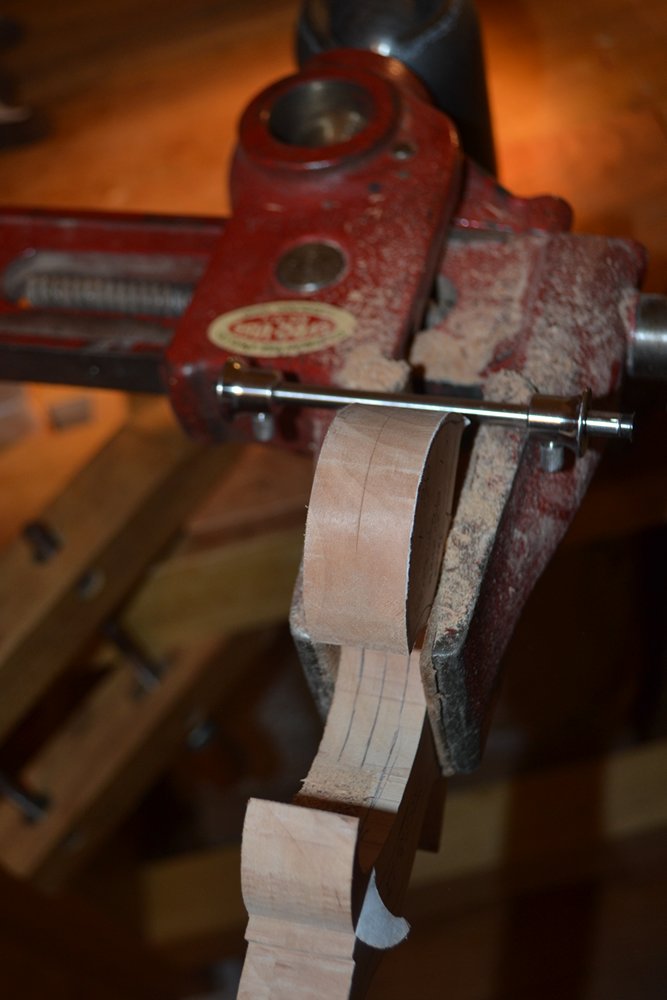
When the nibs are finished, I begin to smooth the outside surfaces of the horn and beak.  This is all done with a Vixen file.  The areas just in front of and behind the nib must be filed straight across the grain, a risky proposition.  Use a light touch and keep most of the pressure on the trailing edge of the file, so as to not chip out the wood on the unsupported side.  File from both directions to avoid removing removing excess material from one side.  Small chips that will not disappear when the edge is rounded over may be reapired with CA glue.
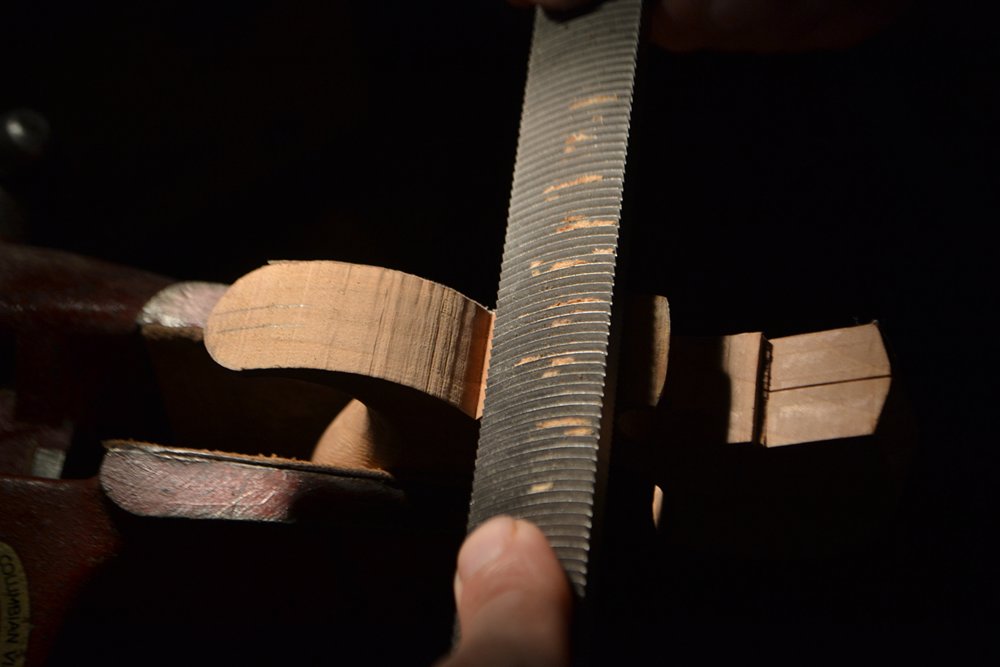
Filing across the grain.  It's really the only way to smooth this area, but it does require a deft touch to avoid spelching.

Filing across the grain. It’s really the only way to smooth this area, but it does require a deft touch to avoid spelching.


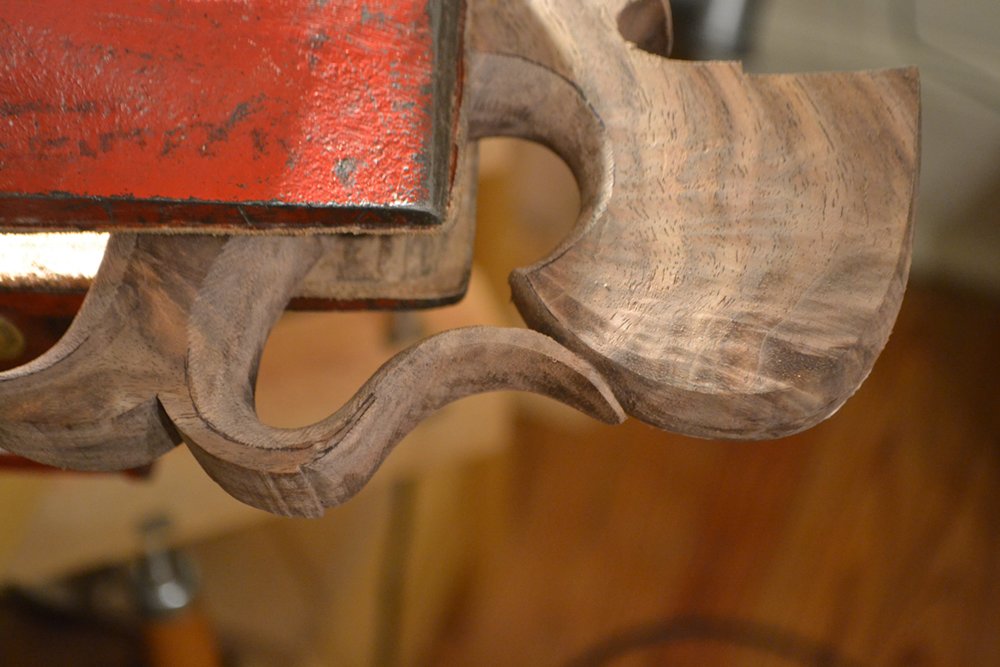
After cleaning up those areas, the rest of the horn and beak can be cleaned up by skewing the Vixen file and filing with the grain.  While doing all of this, stop frequently to feel and look at the curves to ensure that they are fair and that the surface remains perpendicular to the sides
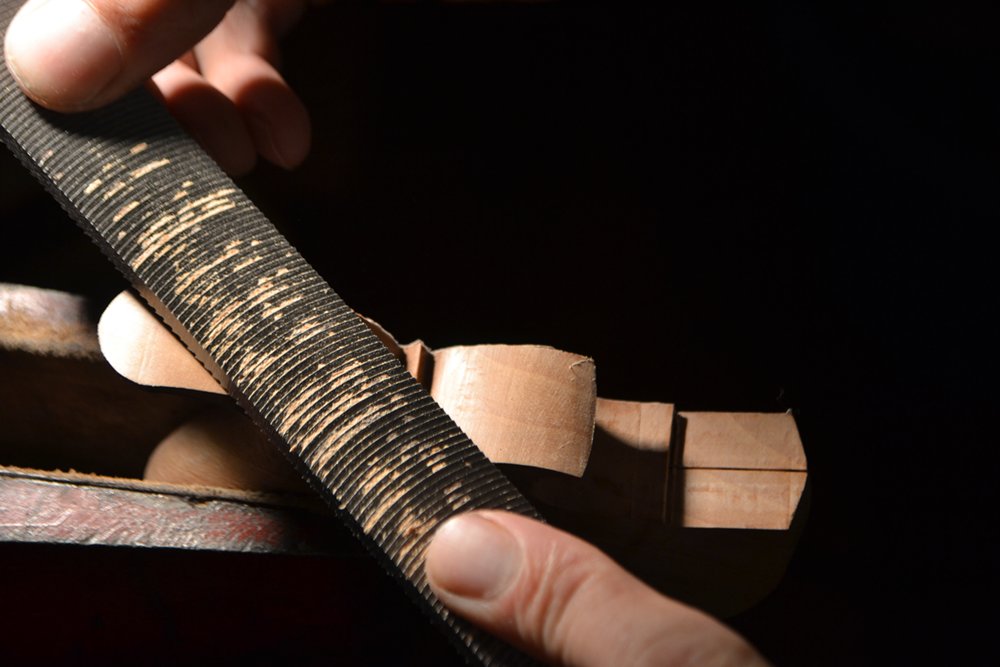
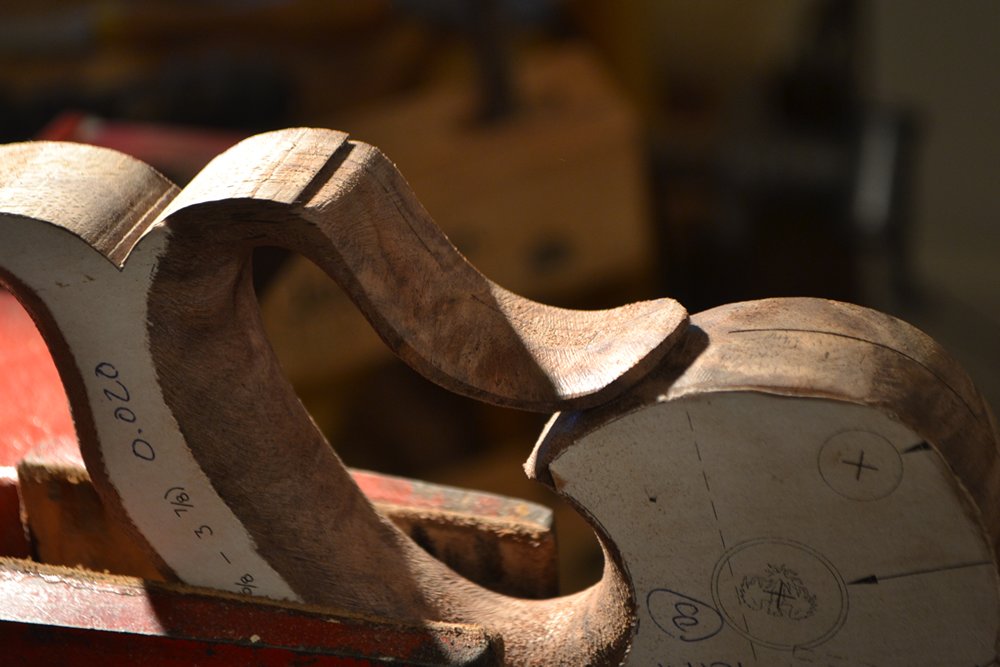
Smooth the remainder of the horn and beak by skewing the file and working with the grain.

Smooth the remainder of the horn and beak by skewing the file and working with the grain.


The nib and horns on the bottom of the handle are cleaned up in an identical manner.
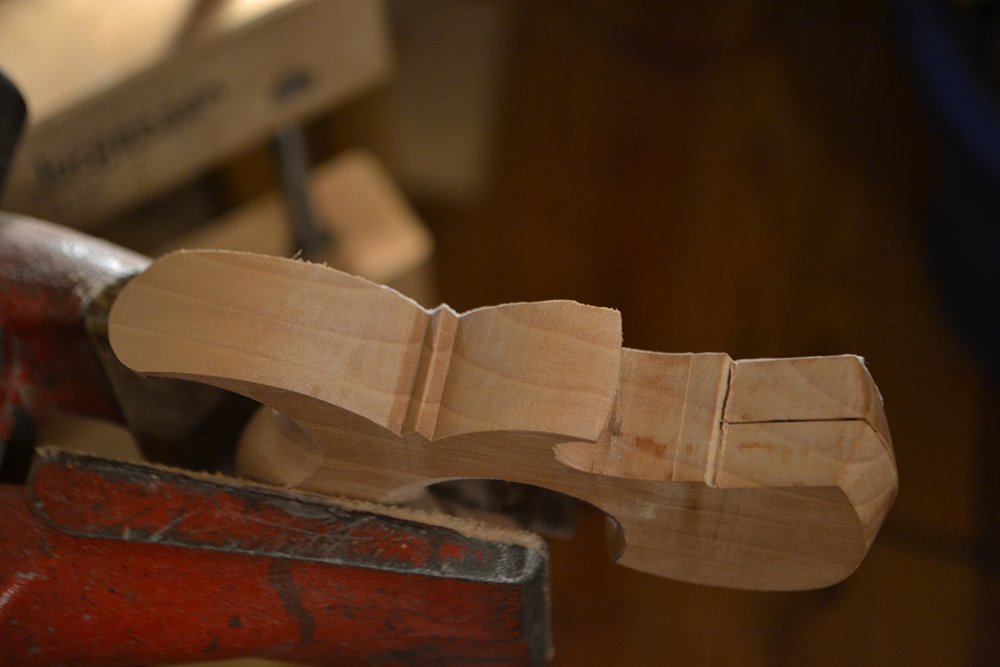
 

The nib and outer surfaces of the horn and beak being smoothed, we now need to turn our attention to the inside of the beak.

The nib and outer surfaces of the horn and beak being smoothed, we now turn our attention to the inside of the beak.


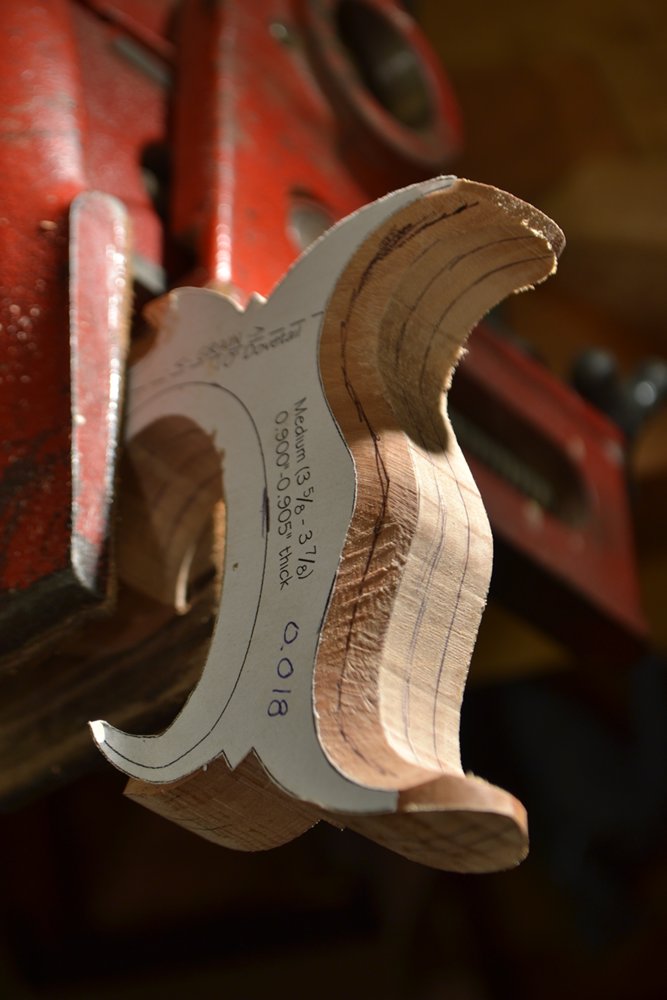
Finally, it is time to smooth the inner surface of the beak, which I do by wrapping a dowel in sandpaper and working it back and forth.  Ideally, the dowel should be sized so that it just fits into the beak when the sandpaper is rolled around it.  Keep the sandpaper moving from front to back so that the transition between the circular portion of the beak and the curve that ramps downward remains smooth.
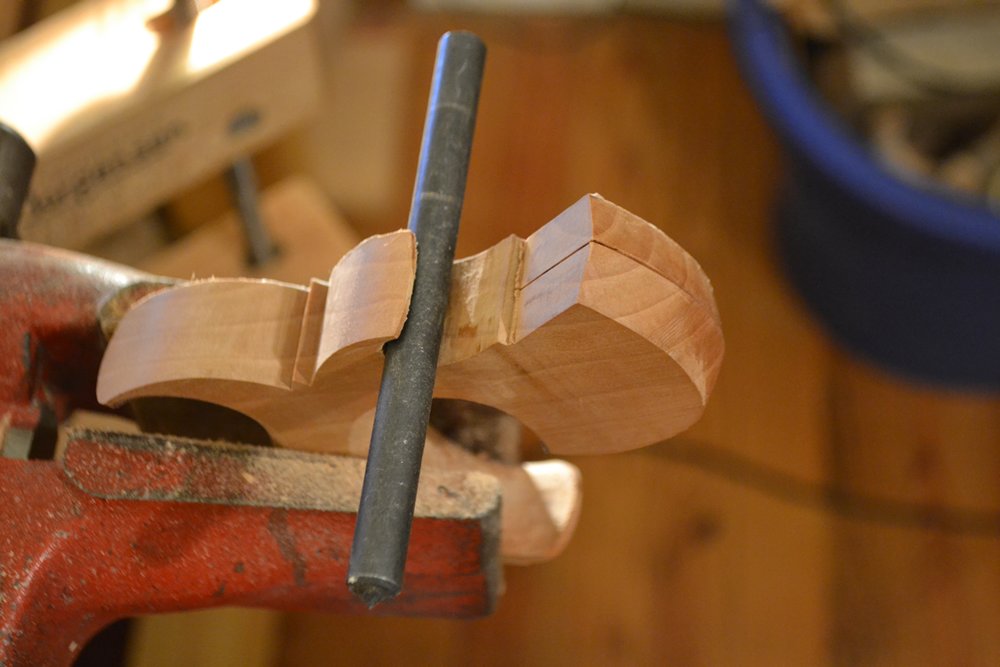
The steel dowel (actually a center punch) that I use.
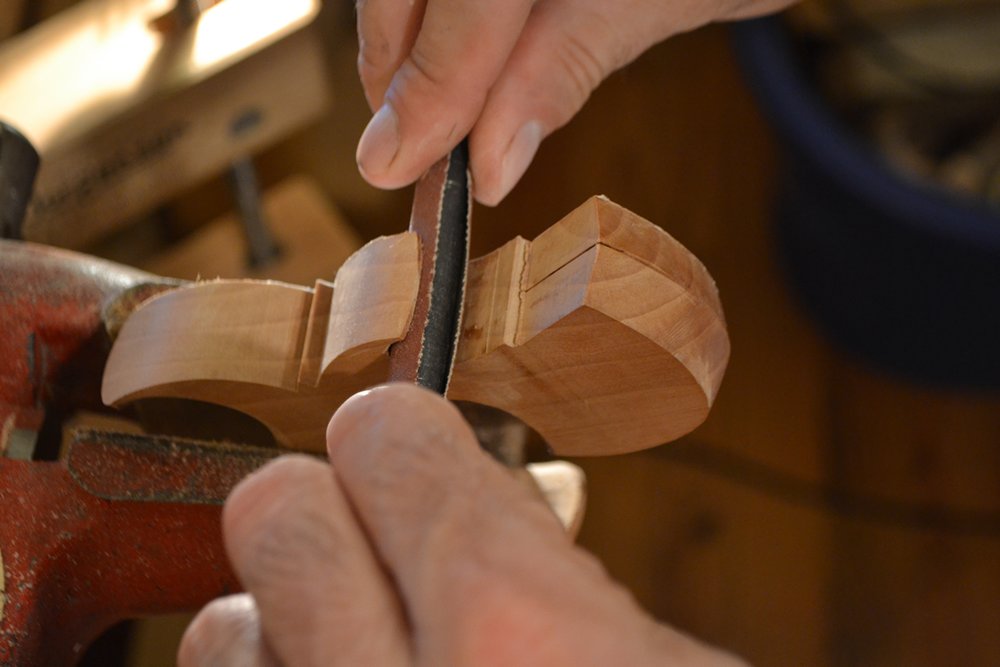
The steel dowel (actually a center punch) that I use.

Sanding the beak.

Sanding the beak.


Next up:  Letting, or mortising, the spine into the handle.
Posted in Saw making | Leave a comment

Website down yesterday

Due to my webhost’s server problems, this website was down for much of yesterday.  It is, of course, back online at this time.

Along with the website being inaccessible, there were some problems with my email account not working at all times.  I believe that all of your emails eventually came through, but I could not view them for much of the day.  If you have not received a response yet, hang in there.  I shall try to catch up with them today.

Posted in Announcements | Leave a comment

Saw build along – Handle, Part IIIA

This is the fourth entry in a nineteen part series that covers the construction of one of my saws from start to finish. For links to the other entries, please see the full chronological index.  -Ed.

Shaping the lamb’s tongue

Since the saw we are following is an open style, there is no return of the handle to the cheeks.  As this is an area of great visual interest, let’s take a detour and document the shaping of the lamb’s tongue and associated areas on a closed handle saw.

Although the lamb’s tongue is deceptively simple to create, this detail can really dress up a handle when properly done.  The bulk of the work in forming it is done with a 6″ slitting file.  This slitting file has a cross section in the form of an elongated diamond, being about 1/8″ thick and 5/8″ wide.

The lamb’s tongue can be carved with chisels, but I find that method slower, as well as riskier (it’s very tempting to pry chips loose, which will often break off the delicate parts of the lamb’s tongue).

There are a lot of angles and curves coming together in this small area, so take your time and study the work often and from varied angles to be certain that the detail emerges symmetrically and with smooth curves.

Lamb's tongue before any refinement.

Lamb’s tongue before any refinement.

Saw kerf that begins to separate the cheek and the tongue.

Saw kerf that begins to separate the cheek and the tongue.

Profile of lamb's tongue drawn.

Profile of lamb’s tongue drawn.

Profile after rouging in with Vixen file.

Profile after rouging in with Vixen file.

The bulk of the work from this point forward is done with a 6" slitting file.

The bulk of the work from this point forward is done with a 6″ slitting file.

Side view of lamb's tongue after roughing out.

Side view of lamb’s tongue after roughing out.

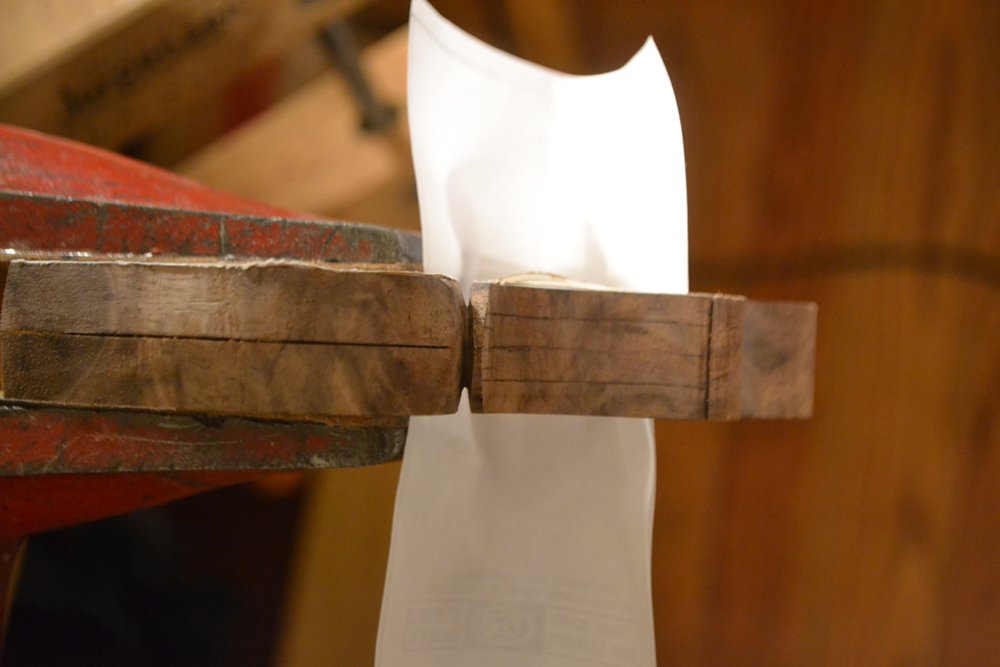
End view of lamb's tongue after being roughed out.  The paper behind it is for contrast.

End view of lamb’s tongue after being roughed out. The paper behind it is for contrast.


The next area of interest is aft of the lamb’s tongue.  The rounded portion is shaped with rasps, using the layout lines as guides to ensure symmetry and smooth curves.  After shaping this area, our attention turns to the notch or clip that marks the transition from that section to the flat, unrounded portion of the handle.
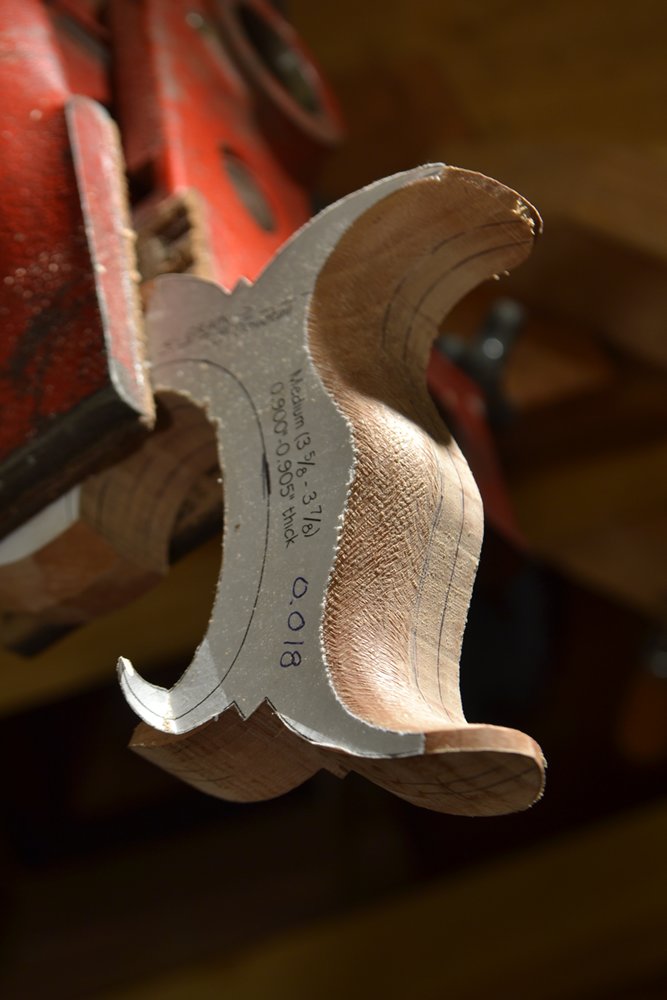
Use a rasp to round over this section of the lamb's tongue.

Use a rasp to round over this section of the lamb’s tongue.


I first clean up the notch with a square and marking knife, then use a chisel to create a flat just in front of that.  Finally, I use a rasp to blend the curves up to meet the notch.

Using a square and marking knife to clean up the notch.

Using a square and marking knife to clean up the notch.

Using a chisel to create a flat just in front of the notch or clip,

Using a chisel to create a flat just in front of the notch or clip.

Notch or clip defined.

Notch or clip defined.


The last step is to narrow the lamb’s tongue, which is easily done with a Vixen file.  After it is narrowed, I round it over a little more to get back to a narrow, consistent flat (which I forgot to document, but should be very easily imagined).

Before narrowing the lamb's tongue.  Like many other details, it is purely decorative, although I suppose it could be argued that it makes it more difficult to catch and break off the delicate end of the lamb's tongue.

Before narrowing the lamb’s tongue. Like many other details, it is purely decorative, although I suppose it could be argued that it makes it more difficult to catch and break off the delicate end of the lamb’s tongue.

Narrowing the lamb's tongue with a Vixen file.

Narrowing the lamb’s tongue with a Vixen file.

After narrowing, but before further refinement to create a consistent flat.

After narrowing, but before further refinement to create a consistent flat.


The lamb’s tongue being now formed, our detour is at an end.  Like many other details on shapely tools, this extra bit of work makes a huge difference in the final look of the saw, helping to move it from a utilitarian realm to one where we find pleasure, and even inspiration, in an object whose beauty exists for no other purpose than filling our desires.

The next entry in this series shall cover cutting the mortise for the spine.

Posted in Saw making | Leave a comment

RakeMaker II update

My apologies to everyone who is waiting for their RakeMaker II.  I modified the design to make it more attractive, and it has taken longer than I expected to pull it all together.

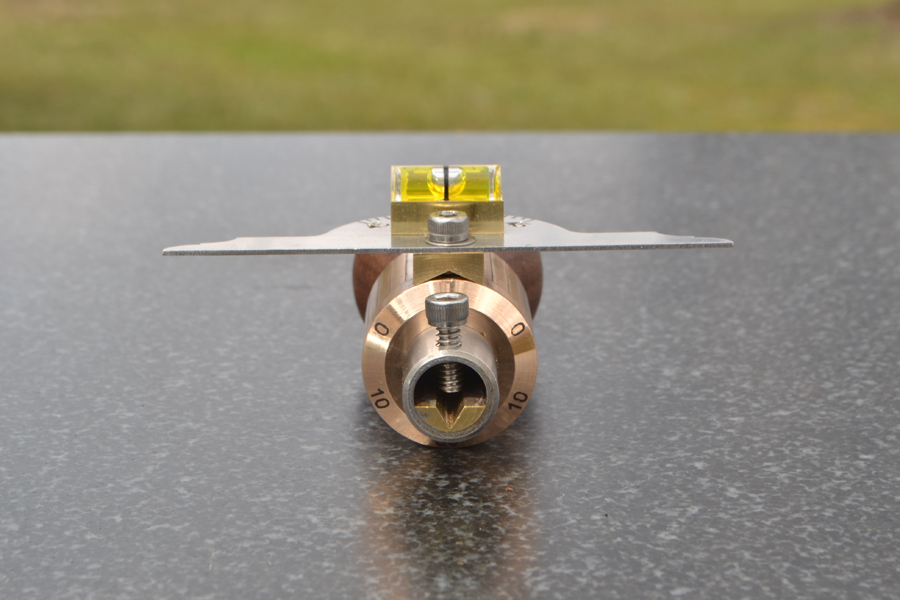
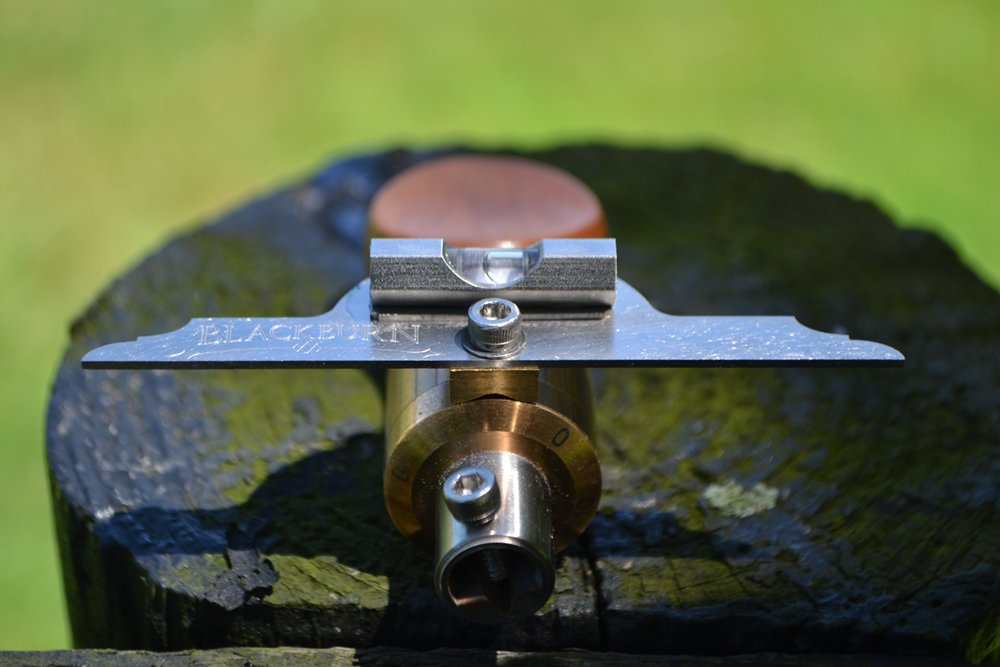
The first design used an acrylic vial mounted on a brass bar.  While serviceable, it looked uncomfortably like an afterthought.  I was finally able to track down a source for glass vials (made in the USA, no less) that were the perfect size for the filing guide.

Being glass, however, they could not just be used in place of the plastic vials, but required a new mounting design.  For protection against accidental drops and bumps, the glass vial is housed in a stainless steel tube with a viewing window milled into it.

This change required some new parts, which I now have.  I am only waiting on the new vials to arrive.  As soon as they arrive, I will begin assembling and shipping the next batch of RM II’s.

If you can hang on for another couple of weeks, I think you will find it was worth the wait.  In the meantime, thanks for your patience.

RakeMaker II, Mk. 1 (with acrylic level vial).

RakeMaker II, Mk. 1 (with acrylic level vial).

RakeMaker II, Mk. 2 (with glass level vial).

RakeMaker II, Mk. 2 (with glass level vial).

Posted in Announcements | 3 Comments

Smith’s Key carcase saw – in the works

I derive much satisfaction from designing and making new (and new to me) tools. Whether it is an original design or a reproduction of an old one, the process of creating that first working model is always a rush.

For some time now, I have wanted to offer an open handled carcase saw.  But rather than simply fitting an open handle on my Disston pattern carcase saw, I wanted to make a saw that had some real differences.  When I was asked to make a version of the 12″ carcase saw in Smith’s Key, I jumped at the chance.  I had never made a saw with a tapered spine, and the dramatically canted blade was also a first.  While the saw presented no technical challenges, I looked forward to testing it.

The saw did not disappoint.  While I cannot say that I prefer the design over my Disston-based carcase saw, its distinctive feel more than stood its ground.  While the Disston pattern carcase saw feels like driving a Cadillac, the Smith’s Key saw feels like being behind the wheel of a Porsche.  Or at least what I imagine that would feel like, since I have never had the pleasure of joyriding in a Porsche.

Knowing that the tapered spine and canted blade worked so well, I decided to take the plunge and come up with my own version of the carcase saw in Smith’s Key.

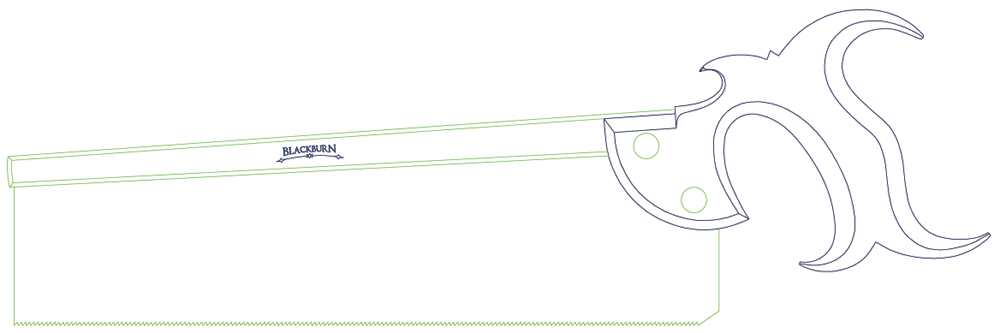
When I draw up a saw handle for my use, I begin by importing one or more pictures of saws and handles into AutoCAD (I do all of my drawing in that program).  Using various features for reference, I scale the picture(s) to full size, then pull out the elements I want to keep, whether they be from one or multiple saws, and add my own touches.  Pulling these elements together is a process of moving, stretching, joining, and fairing the lines until they form a pleasing shape that is properly proportioned.

When I am done, I have a template for the first prototype.  If this works, I go back and resize the handle for different hands.  Parts of the handle can simply be scaled up or down, but much of it needs a little tweaking to look right.

For the first saw, I have the perfect piece of wood – a small piece of elm from my parents’ property that has been air drying since I cut it two years ago.  I have never worked this wood before, but the quartersawn figure looks promising.

Smith's Key 12" carcase saw.

My take on Smith’s Key 12″ carcase saw.


Specifications for the saw:

  • 12″ long at the toothline
  • 2 3/8″ depth of cut at the toe; 2 7/8″ depth of cut near the heel
  • Tapered spine

All of the options that are found on my other saws will also be available on this saw.

I do not have a good estimate of when these will be available on my website, but it will most likely be a few months yet.

Posted in Announcements | Leave a comment

Saw build along – Handle, Part III

This is the third entry in a nineteen part series that covers the construction of one of my saws from start to finish. For links to the other entries, please see the full chronological index.  -Ed.

Slotting and roughing out the handle grip

The last post ended while I was sawing the handle blank out on the scroll saw.  The sawn blank is shown below.  The wood is apple.

Handle fresh from the scroll saw.

Handle fresh from the scroll saw.


Slotting the handle is one of the trickier parts of handle making, so I like to get it out of the way as soon as possible.  The less time invested in a handle, the easier it is to move on should I make a mistake.

Before cutting the slot, I chamfer the front edges of the cheek.  Attempting to chamfer them after slotting often leads to blowout or spelching.  My tool of choice for shaping the chamfer is a ten inch milled tooth file (see picture below).  This particular one is a NOS “Vixen” with fine teeth (18 TPI) on one side and medium  (12 TPI) on the other.

Marking the center of the blade in preparation for chamfering the cheeks.

Marking the center of the blade in preparation for chamfering the cheeks.


I begin cutting the slot on the drill press with a slotting saw of the same thickness as the blade.  I only cut about 1/4″ deep with this saw, then finish the cut up with a saw whose kerf matches that of the blade. I take my time on this cut; an errant or wandering cut can ruin the handle.
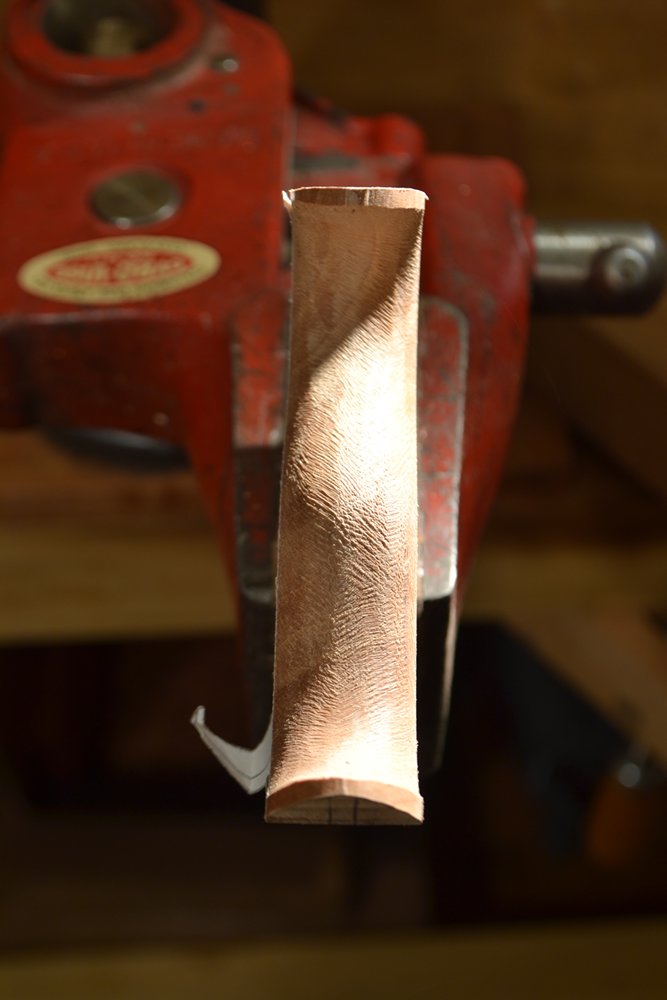
Beginning the slot for the blade on the drill press.

Beginning the slot for the blade on the drill press.

Completing the slot with another saw.

Completing the slot with another saw.


After cutting the slot, it is on to roughing out the grip, one of my favorite parts of making the handle.  This sculpting adds a third dimension to the handle blank, and marks the beginning of its transformation into an elegant and inviting shape.
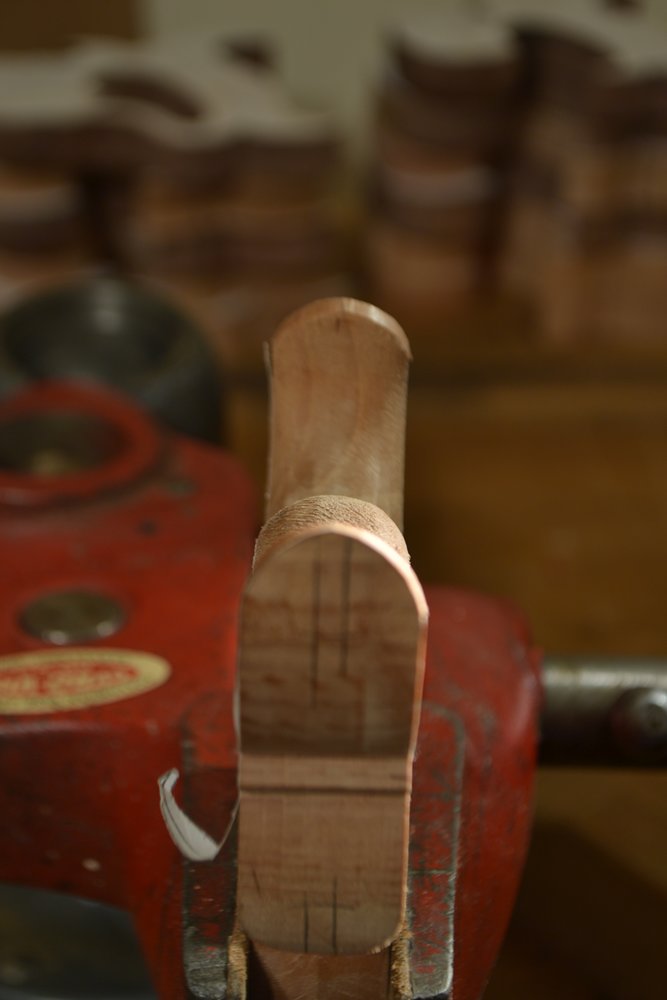
I draw three lines around the inner and outer edges of the grip to divide each into four equal thicknesses.  Lines drawn on the backside of the blank match the curves on the front.  All of these lines are drawn freehand, and they show it at times.

Back side of the handle, with the profile drawn.

Back side of the handle, with the profile drawn.

Outside of the grip, showing the lines that mark the chamfers.

Outside of the grip, showing the lines that mark the chamfers.

Back side of the handle, showing all of the chamfer lines.

Back side of the handle, showing all of the chamfer lines.


The final layout is to round the horns, which is done with a compass.  Rather than rounding the horns to a semicircle, I strike two offset arcs, giving the horns a slightly elliptical profile.  The difference is subtle, but little details and touches add up.

Layout marks for rounding over the horns.

Layout marks for rounding over the horns.

Horns rounded over.  The "Vixen" file makes quick work of this task.

Horns rounded over. The “Vixen” file makes quick work of this task.


I begin roughing the grip out by connecting the line on the face of the handle and the nearest line on the edge.  On this chamfer, I draw a line along the midpoint, then connect that line and the one drawn along the original center.  This second chamfer is somewhat rounded, particularly near the centerline, so as to give a smooth curve.  Most of the work up to this point is done with the large Iwasaki file, although the smaller files and rasps are useful around the horns.

First chamfer completed, layout for second.

First chamfer completed, layout for second.


After these chamfers are completed, I use the handle maker’s files to smooth and blend the curves to a pleasing profile.  Then I do the same with the other side.The horns hinder shaping the curves by eye, save for one vantage point, so fairing the handle to a symmetrical curve must be done by touch.

Second chamfer completed and blended into first.

Second chamfer completed and blended into first.

Both sides chamfered and blended to create a smooth profile.

Both sides chamfered and blended to create a smooth profile.

The lone point where the profile is clearly visible.  All other areas must be faired by touch.

The lone point where the profile is clearly visible. All other areas must be faired by touch.


When the outside of the grip is shaped, the inside is done in the same manner.  Most of the work is done with the handle maker’s file; this is exactly the type of work they are meant to do.  With this done, it really feels like a functional handle.  Indeed, it would make a serviceable, albeit rough, handle.  But there is a lot more potential beauty inside, so further refinement is warranted.

Both inside and outside curves roughed in.

Both inside and outside curves roughed in.

Posted in Saw making | 6 Comments

And now for something completely different…

I always welcome an excuse to try my hand at saws that are outside of my usual patterns, so when a couple of customers requested saws based on late 18th century English saws, I gladly accepted.

The first wanted a saw similar to the carcase saw shown in Smith’s Key.   The defining features of this saw are the heavily canted blade and tapered spine.  While the one shown in the key sports an open handle, the customer wanted a closed handle based on my standard carcase saw (in the London pattern, of course).

Smith's Key excerpt, showing various patterns of saws.

Smith’s Key excerpt, showing various saw patterns.


The spine and saw bolts are bronze.  The handle is European beech.  I experimented with several finishes on this one, and went with a water-based varnish that I wiped on.  Oil-based finishes (including Tru-Oil, my standard finish) had too much color, and tended to muddy the wood, obscuring the grain and figure.

This saw is filed as a dedicated crosscut saw.  It cuts wonderfully, with a very different feel than my standard carcase saw.  It is difficult to describe the difference between the two, but I think the combination of the shallower blade depth and tapered spine make the act of cutting a little more intimate.  I cannot say that I prefer one over the other, but I am a firm believer that most of us can and will adapt to the feel of most any decent saw over time.

A little different take on the Smith's Key carcase saw.

A little different take on the Smith’s Key carcase saw.

Smith's Key carcase saw, handle closeup I.

Smith’s Key carcase saw, handle closeup I.

Smith's Key carcase saw, handle closeup II.

Smith’s Key carcase saw, handle closeup II.

Smith's Key carcase saw, handle closeup III.

Smith’s Key carcase saw, handle closeup III.


The second saw is a close reproduction of the Kenyon Seaton 19″ tenon saw.  This saw also features a canted blade and a tapered spine.  I shortened the blade to 18″, and milled the slot instead of folding it.  The handle is apple, another departure from the original.

The other details are as close to the original as I could make it without ever having seen the original in person.  My guide was a scan from The Tool Chest of Benjamin Seaton, a book that documents Seaton’s tool chest and its contents (thanks to Dominic Greco for the scan).  While the print in the book is of poor resolution, it captured the spirit of the saw and provided some key dimensions.  While a physical examination of the actual saw would surely reveal some variations it and my saw, I am pleased with how it turned out.

Measured drawing of Seaton's19 inch tenon saw by Kenyon, from The Tool Chest of Benjamin Seaton.

Measured drawing of Seaton’s19 inch tenon saw by Kenyon, from The Tool Chest of Benjamin Seaton.


In use, the saw took a little bit of getting used to.  The handle was a little roomier than I am used to, but  after becoming accustomed to that and the low hang of the handle, any fears of the saw being overly heavy and unwieldy were allayed.  Indeed, given the weight and size of the saw, a more aggressively hung handle would likely make the saw difficult to control.

Seaton's Kenyon tenon saw, with apple handle.
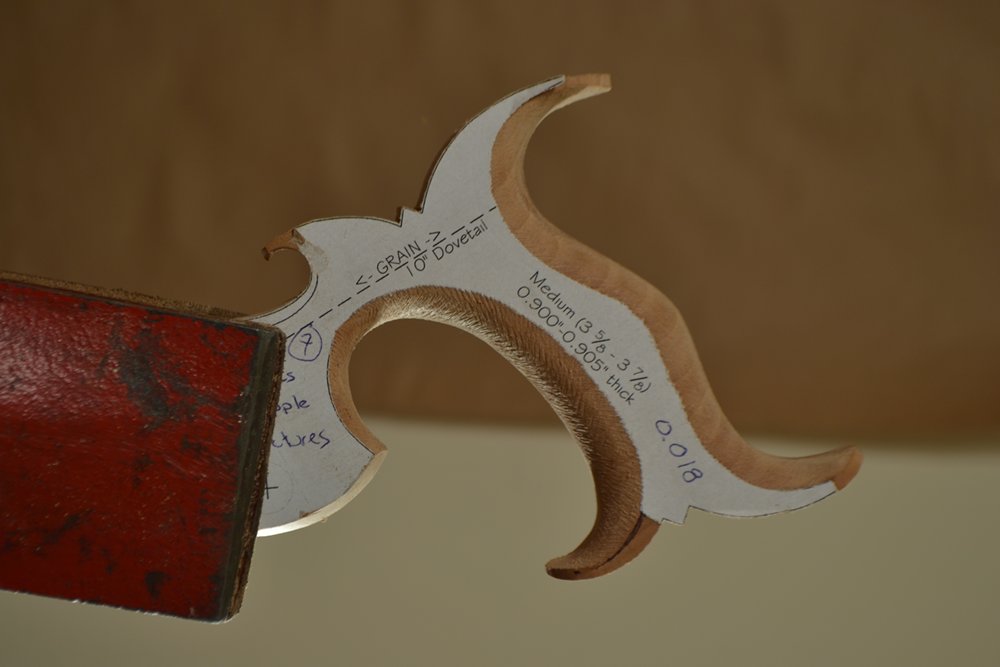
Seaton’s Kenyon tenon saw, with apple handle.

Seaton's Kenyon tenon saw, handle closeup I.

Seaton’s Kenyon tenon saw, handle closeup I.

Seaton's Kenyon tenon saw, handle closeup II.

Seaton’s Kenyon tenon saw, handle closeup II.

Seaton's Kenyon tenon saw, handle closeup III.

Seaton’s Kenyon tenon saw, handle closeup III.

Seaton's Kenyon tenon saw, lamb's tongue detail I.

Seaton’s Kenyon tenon saw, lamb’s tongue detail I.

Seaton's Kenyon tenon saw, lamb's tongue detail I.

Seaton’s Kenyon tenon saw, lamb’s tongue detail I.


Posted in Completed saws - gratuitous pictures | 2 Comments

Saw build along – Handle, Part II

This is the second entry in a nineteen part series that covers the construction of one of my saws from start to finish. For links to the other entries, please see the full chronological index.  -Ed.

Laying out and cutting the blank

After selecting a board for a handle, the fun begins.  I should note that I use the word board loosely, as many of the pieces I use are small pieces that are little larger than the finished handle.  That’s one of the nice things about making saw handles – even small pieces of wood have a chance to be used.

After surfacing and thicknessing the wood to the correct thickness (the thickness increases with the size), one of my favorite parts of sawmaking begins.  Armed with a selection of paper templates, I begin laying them out.  The one constraint in doing this is grain orientation, which is fixed.  Beyond that, I seek to maximize figure and yield. When I am happy with the layout, I glue the paper templates to the wood with glue stick.  Other glues may work, but glue stick works well for me.  It holds well, but releases fairly easily.

Not a lot of options for positioning this one, but it was too nice to go into the scrap bin.

Not a lot of options for positioning this one, but it was too nice to go into the scrap bin.


Once the templates are glued onto the wood, it’s off to the drill press.  My templates have centers marked to drill holes for the inside curves, but I seldom use them all.  I do use them on the inside portion of closed handles and on the beak on the top of the handle.  That area is difficult to sand, and a Forstner bit leaves a smoother curve and better finish that the scroll saw.

After drilling any holes, I cut the handle out on my old 24″ Delta scroll saw.  It is in desperate need of a good cleaning, but for now it just plugs along without any complaints.

Cutting out the handle on my scroll saw.

Cutting out the handle on my scroll saw.


That’s where my pictures leave off, so that’s all for this post.  Next time, I will cover slotting the handle for the saw.

Posted in Saw making | Leave a comment

Saw build along – Handle, Part I

This is the first entry in a nineteen part series that covers the construction of one of my saws from start to finish. For links to the other entries, please see the full chronological index.  -Ed.

Stock selection and preparation

The handle is the most dominant visual part of the saw, and wood selection is critical in making it work.

Stock selection begins at the lumberyard, or in the best scenario, at the log.  I have developed a good working relationship with a local sawyer, who calls when he comes across a promising log.

I work primarily in five woods:  apple, beech (American and European), cherry, and walnut.  There are a few differences between the woods, so I will quickly go over what I look for in each of the woods.

Apple:  Large logs are few and far between, so anything over a foot in diameter is fair game.  Unlike most other woods, I am not interested in using only quartersawn wood.  Quartersawing apple does not reveal a lot of figure or flecking, so the lower yield is not worth it.  For this reason, we cut apple logs through-and-through, yielding a mixture of plain, rift, and quartersawn wood.

Usually apple logs are small enough so that every handle will have both light sapwood and darker heartwood, which makes a striking contrast.  It is also common to find small pin knots, bark pockets, and worm holes.  So long as these do not compromise the strength of the handle, I see these as enhancing the character of the wood, and not as something to be worked around.

Apple, showing the contrast between the lighter sapwood and darker heartwood.

Apple, showing the contrast between the lighter sapwood and darker heartwood.


Beech:  European and American beech are similar in that both reveal their best figure when they are dead quartersawn.  Fortunately, imported European beech is usually cut in this manner.  American beech, on the other hand, is not highly sought after and can be hard to find in any form, let alone quartersawn.  When we saw a beech log, every cut is made to maximize the yield of quartersawn lumber.  In beech, it is very important that the wood be truly quartersawn, for the figure drops off very quickly with just a few degrees of variation from quartersawn.  The yield is lower in this method, but the resulting figure is very striking and worth the trouble.

I use both the sapwood and heartwood, and often in the same handle.  The color difference is not stark, and diminishes over time as the wood mellows.

Quartersawn American beech, one of the truly beautiful (and underrated) hardwoods of North America.

Quartersawn American beech, one of the truly beautiful (and underrated) hardwoods of North America.


Cherry:  Cherry is similar to beech in that the quartersawn form reveals a striking ray or flecking pattern.  Unlike beech, it is a desirable furniture wood and is widely available.  When working with cherry, I use only the heartwood, as the white sapwood does not fare well when compared to the rich red tones of the heartwood.

An exceptional piece of quartersawn cherry, sent to me by a customer.

An exceptional piece of quartersawn cherry, sent to me by a customer.


Walnut:  I use two variations of walnut for my handles.  The first is quartersawn.  While there is no stark difference between quartersawn and plainsawn figure, the quartersawn grain looks a little cleaner and is slightly stronger and more stable.

Walnut crotch is one of the most beautiful North American woods.  It is, as its name betrays, cut from the fork of a tree.  The best figure comes when the fork is split so that the sawn faces form a “Y”.  The figure comes from the interaction and intertwining of the grain in the two branches, and ranges from barely noticeable to spectacular.  Not every crotch will have this figure, and those that do have little of it, usually yielding just two or three slabs with this figure.

Walnut crotch, with its typical swirls, rays, and variegated grain.

Walnut crotch, with its typical swirls, rays, and variegated grain.

Posted in Saw making | 7 Comments

Saw handle templates/patterns now available for download

If you are thinking of trying your hand at sawmaking, you may find the new templates I posted of some help.

These templates are in pdf format, so it is easy to print them out at full scale on 8 1/2 x 11 paper.  The patterns cover a full range of hand sizes, so everyone should be able to find one that fits.

Right now, I have handles for 10 inch, 12 inch, and 14 inch backsaws.  I will expand that lineup in the future, to eventually cover the full spectrum of backsaws.

If you need hardware for your new saws, I sell saw bolts and nuts in various sizes (including blank medallions).  Slotted spines are coming in the fall, as well as saw plates.

Posted in Announcements | Leave a comment