Burr saw toother update

For the past month, I have been sporadically working on the Burr toother I bought in January. While the machine had little wear, it did need some attention. The most pressing need was to sharpen the punch and die. A few minutes on my friend’s grinder took care of that.

Grinding the die.

Grinding the die.


When the grinding was done, I mentioned needing a new motor for it. I should have known that he would have the perfect one for this machine – a 1/4 HP Wagner, decades older than the machine itself, with classic cast iron styling. Weighing in at over 30 pounds, there is nothing frail about this motor.

This has no particular elevance, but you have to appreciate the beauty and durability of this nameplate.

This has no particular relevance, but you have to appreciate the beauty and durability of this nameplate.


Other than a light cleaning, the machine itself needed no real work. The design is simple, rugged, and machined to very tight tolerances. A few new bolts and nuts and a spring  were all that was needed to bring it back to good operating condition.

Broken down and cleaned.

Broken down, cleaned, and ready for reassembly.

Setting the clearance between the die and punch. I used a sheet of newspaper for a shim.

Setting the clearance between the die and punch. I used a sheet of newspaper for a shim.

Marking out the scale for rake angles. The toother can be set for any rake angle between 0 and 30 degrees.

Marking out the scale for rake angles. The toother can be set for any rake angle between 0 and 30 degrees.

Another view of the toother and motor.

Another view of the toother and motor.

The finished toother.

The finished toother.

The back side of the toother and motor.

The back side of the toother and motor.


The carrier and ratchet bars were a little rough, and only went as fine as 11 ppi. Since most of my saws are more finely toothed than that, I had a new set of ratchets and carriers made. Unlike the original ratchet bars, the new ones are double-sided, and are cut for 9, 10, 11, 12, 13, 14, 15, and 16 ppi. By skipping every other tooth, they can also do 5, 5 1/2, 6, 6 1/2, 7, 7 1/2, 8, and 8 1/2 ppi, respectively. Yes, the math to come up with those numbers makes my head hurt, too.

The new carrier and ratchet bars.

The new carrier and ratchet bars.

The carrier is made in two pieces, then spot welded together.

The carrier is made in two pieces, then spot welded together.

The stop that the ratchet bars butt up to. Unlike the original ratchet bars, the new ones are double-sided.

The stop that the ratchet bars butt up to. Unlike the original ratchet bars, the new ones are double-sided.

A ratchet bar in place.

A ratchet bar in place.


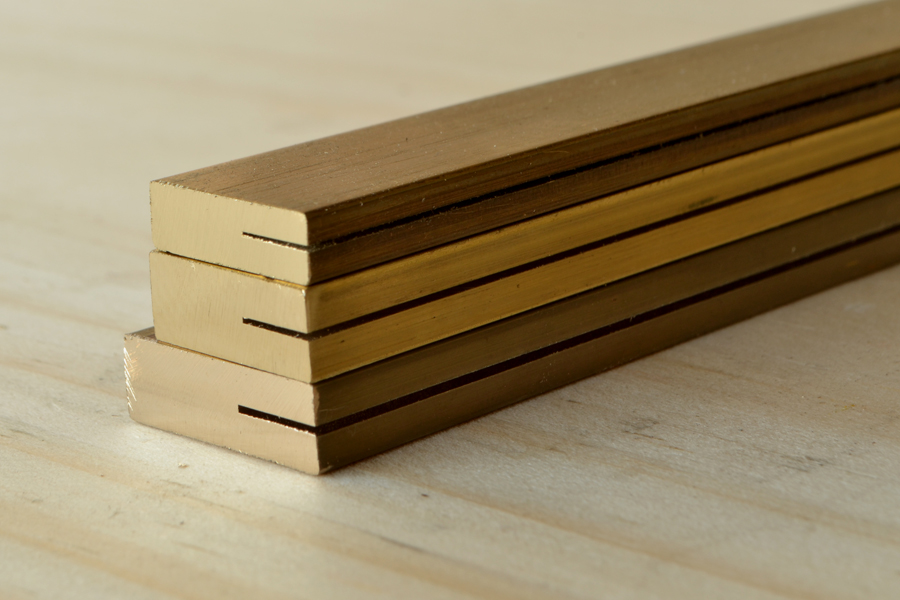
Since the new carrier looked so much better than the old, I needed to make new clamps for it. These are made from bronze bar, with a milled slot for relief and clearance, and have brass studs soldered into them.

Bronze bar for clamps, after milling and tapping.

Bronze bar for clamps, after milling and tapping.

Bronze bar cut into lengths, with threaded rods.

Bronze bar cut into lengths, with threaded rods.

Threaded rods soldered into bars.

Threaded rods soldered into bars.

How the clamps work.

How the clamps work.


With all of the hard work done, there was nothing left but to spin it up and punch a few teeth. The first video shows the toother on a dry run. The second shows me toothing a scrap piece of saw plate to 10 ppi, and the third is a dimly lit closeup view of the punch. Because they were taken before I got the new carrier back from the welder, I used the old carrier bar. It works exactly the same as the new, but the new looks much better doing it.


Test plate after toothing.

Test plate after toothing.

Closeup of test teeth. The rake on this is about 30 degrees, which is rather relaxed.

Closeup of test teeth. The rake on this is about 30 degrees, which is rather relaxed.

Posted in Saw filing, Saw making, Tools of a saw wright | 7 Comments

Frame saw build along – wood selection and design

I have wanted to build a frame saw for years. I have no pressing need for one, and don’t know if I will use it regularly, but have always admired the graceful forms that some of these saws take on.

I am fortunate to have accumulated a variety of domestic woods over the years, and have access to even more. I thought of using black locust, ash, and a few others, but finally settled on beech. Strengthwise, it is comparable to ash and within spitting distance of most hickories and black locust. Although splitting or riving the arms from the log was my first instinct, I already have a large amount of straight-grained and quartersawn beech. It has been air drying for 18 months, and its moisture content is down to around 12%, so work can begin immediately.

Measuring the moisture content.

Measuring the moisture content.

Quarter-sawn and stright grained, with some nice ray flecking.

Quarter-sawn and stright grained, with some nice ray flecking.


With the wood chosen, I moved on to sketching out the arms. Almost everything I have drawn in the last few years has been done with a mouse and on a screen. While the computer has certain advantages, I dug out my old lead holders, French curves, scales, and eraser, and sat down at the kitchen table for this project.

The next several hours were very enjoyable, and reminded me of just how easy it is to get lost with a pencil and paper. The different feels of soft and hard lead on paper, sketching out and shifting lines, shading, and erasing – these all provide freedom from the mathematical constraints of computerized design.

To really understand why a tool has the form it does, there is no better start than to begin sketching it out. Try changing the shapes, curves, and proportions, and you will most likely learn that, for the most part, these shapes have evolved deliberately and logically.

As a case in point, my first sketch had the arms curving outwards. The shape pleased me, and I wondered why I had never seen it elsewhere. As I sketched on, I realized that the outward curve would force the tensioning string to slip down towards the stretcher. While the string can be held in place by passing it through an eye or around a nock, the better design uses the geometry of the curves to keep it in its place.

An early sketch. When the cord is tensioned, it will wedge itself into the return of the eye.

An early sketch. When the cord is tensioned, it will wedge itself into the return of the eye.


I finally finished this design in the early hours of the morning, and think it will be a good jumping off point. It will undoubtedly be refined (hopefully for the better) as I translate the sketch into wood. For now, the sketch hangs above my bench where I can glance at it throughout the day. Doing this is a good way for me to see it from different angles and through fresh (and sometimes tired) eyes, often revealing subtle imperfections and unfaired curves.

Sketch of the arm and stretcher.

Sketch of the arm and stretcher.


Since this is my first frame saw, there will be some missteps along the way. If anyone has some friendly advice or criticism about the project, I welcome your comments.

Posted in Saw design, Saw making | 4 Comments

PATINA Auction 2014 (Saturday, March 15)

The annual PATINA auction is one of the largest and best old tool events around, and for the second consecutive year, the saw elves and I will make the short trek to set up and sell some of our tools.

I am the least of the attractions, however.

If the weather cooperates, tailgating starts at 0-dark-thirty (seriously, it starts well before any sane person is up), and continues into the early afternoon. There are dozens of sellers set up, and many bargains to be found. Do make sure to bring a flashlight, though, or you may never find them.

Early entry into the hall begins at eight (for a $15 fee), and opens to all at nine (no charge). Inside are scores of dealers and sellers, with tools ranging from affordable users to the rare and collectible.

Finally, the auction begins at 2 pm, and goes until all 291 lots have been sold.

And if you need any further incentive, the elves have been hard at work baking cookies. They will have their shop set up during tailgating and inside the hall, with some of the best homemade cookies and hot chocolate around.


PATINA 2014

Saturday, 15 March

10211 Lewis Drive, Damascus, MD 20872

Posted in Shows | 6 Comments

Closing the slot: An addendum to “Saw build along – Back, Part III”

One of the posts in my saw build along series showed how I squeeze the slot closed so that the blade is held in the back by friction. Although this works well for me, it requires the use of a hydraulic press that is not likely to be found in most workshops. The method shown below requires nothing more than an ordinary machinist’s or mechanic’s vise and two short pieces of aluminum angle.

Before squeezing the slot closed, I now chamfer the edges of the blade slot slightly. I use an old needle file to cut the chamfer, but any file with a sharp corner will work. This chamfer, along with the roundover on the edge of the blade, makes it easier to install the blade into the back.

Chamfering the edges of the blade slot.

Chamfering the edges of the blade slot.

Chamfering the edges of the blade slot.

Chamfering the edges of the blade slot.

End view of back or spine.

End view of back or spine.


To squeeze the slot, I line the jaws of the vise with aluminum angle to prevent the steel jaws from marring the brass. I had some 3/4″ x 3/4″ x 1/8″ angle laying around, but the actual size is not too important.

To concentrate the force on a shorter section of the back, I cut one of the pieces to 1″, which means that you will need to squeeze the blade in 1″ increments along its length. I also trimmed one of the legs to a 3/8″ width so that I could keep the force at the edge of the back (first picture below).

Squeezing slot closed, end view.

Squeezing slot closed, end view.

Squeezing slot closed, top view.

Squeezing slot closed, top view.


There are a few things to keep in mind when doing this:

  • The force required to close the slot in a brass back is much greater than that for a bronze back.
  • The slots in brass backs will spring back open when the vise is opened, and may require multiple squeezes before it takes a set.
  • If you are unable to generate enough force to close the slot up, try a bigger vise. Or, cut the angle shorter; by halving the length of the aluminum angle, you effectively double the force applied to the back.
  • A set of feeler gauges is invaluable in measuring how wide the slot is. These have many uses around the shop, and can be had for short money at most auto parts or hardware store.
  • Aim for a slot that is about 0.002″ – 0.009″ narrower than the blade (the thicker the blade, the more you can close the slot up without getting in trouble). This difference generates enough friction to securely hold the blade without making it overly difficult to install the blade.  For the math averse, I have included a short table at the end showing the slot widths that I use for various blades.
  • Above all, take it slowly. It is far, far easier to squeeze the blade back (Corrected 28 Feb 2014. Does no one proofread these entries? – Ed.) a little more than it is to try installing a blade into a slot that is mashed shut.
Feeler gauge set.

Feeler gauge set.

Blade thickness and slot width table. Includes metric measurements for use in the civilized (civilised?) world.

Blade thickness and slot width table. Includes metric measurements for use in the civilized (civilised?) world.


Posted in Saw making | 6 Comments

An interesting miter box – updated

About a week ago I posted some pictures of this miter box, along with a request for any information about it.

Union No. 2 miter box - picture 1.

Union No. 2 miter box – picture 1.


A big thanks to Jeff Burks (frequent contributor to the Lost Art Press blog and the man who may know more about US hand tool patents than anyone else alive) for finding the patent document that the miter box was based on. That patent is No. 847,557, issued on March 19, 1907 to Peter Dosch.

Among the thousands of patents pertaining to saws that Jeff has assembled is a volume that is devoted solely to miter boxes. This searchable pdf (more that 2,800 pages of scanned documents) is his attempt to catalog all known US patents pertaining to hand-powered miter boxes.

Posted in Uncategorized | Leave a comment

Now selling slotted saw backs / spines

For those of you making your own saws, I now sell slotted saw backs. These spines are of the highest quality, with precisely milled slots that will require a minimum of adjustment to end up with a straight and true blade.

Standard sizes range from nine to eighteen inches, covering everything from small dovetail to large tenon saws.

Slotted saw backs.

Slotted saw backs.


Saw bolts and nuts, of either the split nut or truncated cone variety, can also be purchased.

Those who remember my entry about the Burr toother can surely see the next step. If all goes well, my new toother will be up and running within the next month or two, enabling me to efficiently tooth saw blades and offer complete kits.

Posted in Announcements | Leave a comment

An interesting miter box

Monday, besides bringing the beginnings of a nice little snowstorm, brought an email from a reader with some questions about a fascinating cast miter box. It is a Union No. 2, but beyond that I know nothing about it. I don’t have any old Union tool catalogs, and have not been able to find any pictures or references to this model online.

I have to admit that I cannot recall seeing one like this, so suspect that it is not very common. Does anyone have any knowledge of this model that they can share? Age, scarcity, or even a catalog reference to it would be of great interest. Please leave a comment or email me with any information.

Union No. 2 miter box - picture 1.

Union No. 2 miter box – picture 1.

Union No. 2 miter box - picture 2.

Union No. 2 miter box – picture 2.

Union No. 2 miter box - picture 3.

Union No. 2 miter box – picture 3.

Union No. 2 miter box - picture 4.

Union No. 2 miter box – picture 4.

Union No. 2 miter box - picture 5.

Union No. 2 miter box – picture 5.

Union No. 2 miter box - picture 6.

Union No. 2 miter box – picture 6.

Union No. 2 miter box - picture 7.

Union No. 2 miter box – picture 7.

Union No. 2 miter box - picture 8.

Union No. 2 miter box – picture 8.

Union No. 2 miter box - picture 9.

Union No. 2 miter box – picture 9.

Posted in Uncategorized | 5 Comments

A reader came through in a big way…

After checking on its progress several times each day, these highly anticipated boxes showed up on my doorstop late this week. How the UPS driver managed to sneak 80 pounds onto my porch (where it sat for at least 45 minutes!) despite my vigilant watch still baffles me.

The highly anticipated packages.

The highly anticipated packages.

The tension mounts...

The tension mounts…


After a promising lead on a Burr toother on Craigslist fell through, I posted here in hopes of bringing one to light. Given their scarcity, it was a move of desperation with little hope of any results.

To my surprise, and delight, a reader emailed with an offer to sell me his machine. The only obstacle was international shipping, but a few quotes showed that this was a feasible proposition. The seller really went above and beyond any expectations I had in his speed and care in shipping. Less than a week later, I was opening the crate.

...until I finally get my first glimpse of my new toother, unharmed.

…until I finally get my first glimpse of my new toother, unharmed.


While the machine arrived in good condition (thanks again for that stellar crating job!), it does need some work before I am ready to start punching teeth. Nothing that is unexpected, but modifications that will make it more efficient to use. Check in later for updates…

Posted in Saw filing, Saw making, Tools of a saw wright | 4 Comments

Drilling holes in saw blades

One of the most commonly asked questions related to sawmaking is how to drill or punch holes in the blade for the bolts.

The first tool most people turn to is an ordinary twist bit. Unfortunately, a good saw blade has a Rockwell hardness around Rc50, which is hard enough to foil most HSS or cobalt drill bits. You may be able to spot anneal the blade or use a very sharp bit with lots of coolant, but these are workarounds for a tool that is not appropriate for the task. What, then, to try next?

One viable option is a punch. A good one, such as those made by Roper Whitney, will work well, but does represent a substantial investment (unless you luck into a good used one). Depending on the model, they may struggle with some of the thicker plates.

Coming back to drill bits, there are two big requirements. The first is that it must cut a relatively hard material. The second is that it must make a clean hole in sheet metal, and exit without “grabbing” the material.

The first requirement pretty much narrows the field down to bits that are either solid carbide or carbide tipped. The second eliminates ordinary twist drill patterns*.

Looking at what this leaves, I am aware of at least four different options. I have used two of these, and heard of others using the other two with success.

  1. Carbide tipped masonry drill bits: These are the first bits I tried. Most of them will need to be sharpened, which must be done with a diamond stone or a green wheel on a grinder. Once sharpened, they work well (I have used them in an eggbeater drill). Just don’t overheat them, or the brazing will melt and the carbide tip will fall out.
  2. Carbide tipped tile or glass drill bits: These are similar to the masonry bits, but I have never tried them. I would guess that they are sharper out of the box, but they may still need to be sharpened.
  3. Multi purpose drill bits: Made by Bosch and others, these are another carbide tipped bit. I have never used them myself.
  4. Solid carbide spade drill bit: The cutting geometry is specifically designed for sheet metal, and the carbide will cut through even hardened tool steel. The only drawback is that they really need to be used in a drill press. Yes, I sell these, but only because they are an excellent tool that I personally use. 

The video below shows me drilling the blade. I do this with the handle in place, so there is no chance of marking error. The handle itself was drilled in a previous step (these bits will not drill wood).


This second video is just a demonstration of how well these bits cut. The saw blade is 0.042″ thick spring steel (the same as I use in my saws).


*There are some workarounds, such as drilling through a piece of cloth, sandwiching the blade between wood or thicker metal plates, or regrinding the cutting edge (no easy task with a carbide bit). However, you still need to use a carbide bit. 

Posted in Saw making, Tools of a saw wright | 2 Comments

Good bye, Fred

One of the best parts of this job is meeting and getting to know many of my customers. It is truly satisfying to interact with people happy to buy what I make. Among all of these people, Fred West truly stood out.

Up until a year ago, I had never heard of Fred. That changed when he called to order one of my saws (and one of everything else I made) after having seen a saw I had made for one of his friends. I had the good fortune to live just a few miles away from him, and so was able to deliver it in person. During the hour we talked, his passion for fine tools became evident.

Over the following months, he offered much needed encouragement, and became a better salesman for my tools than I am. When he ordered a new tool, he had a way of making me feel that I was the one bestowing honor upon him by making it.

I saw him one final time at WIA 2013, where he left me in awe of his enthusiasm and generosity.

So good bye, Fred. I’m glad I knew you, and only wish I’d had time to fill your last order.

Posted in Uncategorized | 2 Comments