Wanted to buy: Burr saw toother / retoother

I really, really, want a Burr toother / retoother. If anyone has a lead on one that may be for sale, I would love to hear about it. Rust is ok, so long as the die does not have large chips.

The carrier bars and ratchets would be a bonus, but I can fabricate them if they are missing.

Does not need to have a motor, and I am willing to pay for shipping.

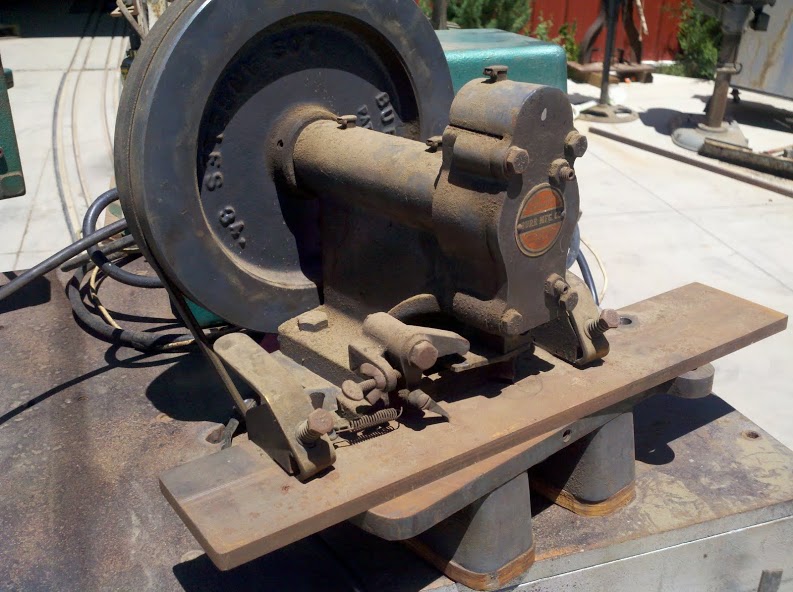
For reference, here is a picture of one.

Burr Mfg. Co saw toother / retoother (the handles that hold the table in place are missing on this one).

Burr Mfg. Co saw toother / retoother (the handles that hold the table in place are missing on this one).


If you know of an available one, please leave a comment or send me an email.

Posted in Uncategorized | 7 Comments

Saw build along index

Since the saw build along entries contained some useful information, I have created this entry as an index for the series. This index lists the entries in chronological order, which corresponds closely to the order in which I work.


Saw build along – Handle, Part I – Stock selection and preparation

Saw build along – Handle, Part II – Laying out and cutting the blank

Saw build along – Handle, Part III – Slotting and roughing out the handle grip

Saw build along – Handle, Part IIIA – Shaping the lamb’s tongue

Saw build along – Handle, Part IV – Cleaning up the nibs, beak, and horns

Saw build along – Handle, Part V – On letting the spine into the handle

Saw build along – Handle, Part VI – Lamb’s tongue & chamfer

Saw build along – Handle, Part VII – Sanding the handle

Saw build along – Handle, Part VIII – Boring the holes for saw nuts & bolts

Saw build along – Handle, Part IX – Finishing

Saw build along – Blade, Part I – Cutting the blank

Saw build along – Back, Part I – Shaping the back (spine) 

Saw build along – Back, Part II – Sanding & deburring the back

Saw build along – Back, Part III – Stamping & closing the slot

Saw build along – Back, Part III addendum – An alternate method of closing the slot

Saw build along – Blade, Part II – Debluing & deburring the blade 

Saw build along – Assembly, Part I – Fitting the back & blade

Saw build along – Assembly, Part II – Straightening the blade

Saw build along – Assembly, Part III – Drilling bolt holes, toothing, final assembly, and test cuts

Saw build along – saying goodbye…

Posted in Saw making | 3 Comments

A few Ready To Ship saws added

All of these are available for immediate shipment. Click on the heading of each saw for more pictures. Specifications and order buttons for each saw are on my Ready To Ship page.


10″ dovetail saw with large rift-sawn cherry handle

Filed 15 ppi rip.

Ten inch dovetail saw with large rift-sawn cherry handle.

Ten inch dovetail saw with large rift-sawn cherry handle.


12″ carcase saw with large curly walnut handle

Filed 13 ppi rip. Left-handed (stamp and bolt heads on what is usually considered the backside).

Twelve inch carcase saw with large quartersawn walnut handle.

Twelve inch carcase saw with large quartersawn walnut handle.


14″ sash saw with medium cherry crotch handle

Filed 12 ppi hybrid.

Fourteen inch sash saw with cherry crotch handle.

Fourteen inch sash saw with cherry crotch handle.

Posted in For sale | Leave a comment

Left-handed saw option added

This is a long overdue option, particularly since I am left-handed.

Left-handed saws simply have the bolt heads and the spine stamp on what is usually considered the back side. There is no difference in the shape of the handle or the filing.

Left-handed models are specified using the drop down menus on the order pages. Anyone with a pending order can email me to request this option on their saw(s).

Posted in Announcements | Leave a comment

It’s a live…

…a live edge, that is.

After seeing several infill planes in desert ironwood, a customer sent me a piece of his own to use for a saw handle. This saw had two firsts for me – working with desert ironwood and using a live edge on a handle.

Front side of the handle blank.

Front side of the handle blank.

Back side of the handle blank after scraping off most of the wax.

Back side of the handle blank after scraping off most of the wax.

Back side of the handle blank after planing.

Back side of the handle blank after planing.


The wood showed a remarkable range of colors, figure, and patterns in a remarkably small space. But the most intriguing feature was the live edge that begged to remain a part of the saw. Fortunately, the customer gave me license to use it as I saw fit.

After looking at many possible layouts, the best location for the live edge was at the top of the handle. Placing it elsewhere would have either interfered with the grip of the saw or led to much of its loss when rounding over and shaping the contours.

The wood was nice to work with, although slightly prone to chipping. Finishing it, on the other hand, was a true struggle. Tru-Oil, my usual finish of choice, would not cover evenly, and never did completely dry. Shellac showed a lot of promise, but I was unable to get the smooth finish I wanted. Others with more experience have used shellac with great success, so I can only conclude that it was my technique.

Being stubborn (or persistent, depending on your point of view), I next tried a base coat of shellac followed by Tru-Oil. This was nearly successful, but I still had trouble getting a consistent sheen, and each coat of Tru-Oil took several days to dry thoroughly.

In the end, I removed all of the finish, sanded to a high grit, then buffed the bare wood with carnauba wax. It does not have the high gloss of a film finish, but it has a very consistent sheen, shows off all of the color and figure, and feels amazingly smooth in my hand. Thanks again to the customer for showing great patience as I did a bit of on-the-job learning.

This saw is a left-handed model, which simply means that the bolt heads and the stamp are on what is usually considered the backside.

Front side of the saw. Yes, this is a left-handed model.
Front side of the saw. Yes, this is a left-handed model.

Closeup of the handle.

Closeup of the handle.

Closeup of the handle.

Closeup of the handle.

Closeup of the handle.

Closeup of the handle.

Closeup of the handle.

Closeup of the handle.

Posted in Completed saws - gratuitous pictures | 4 Comments

Now selling truncated cone saw bolts and nuts

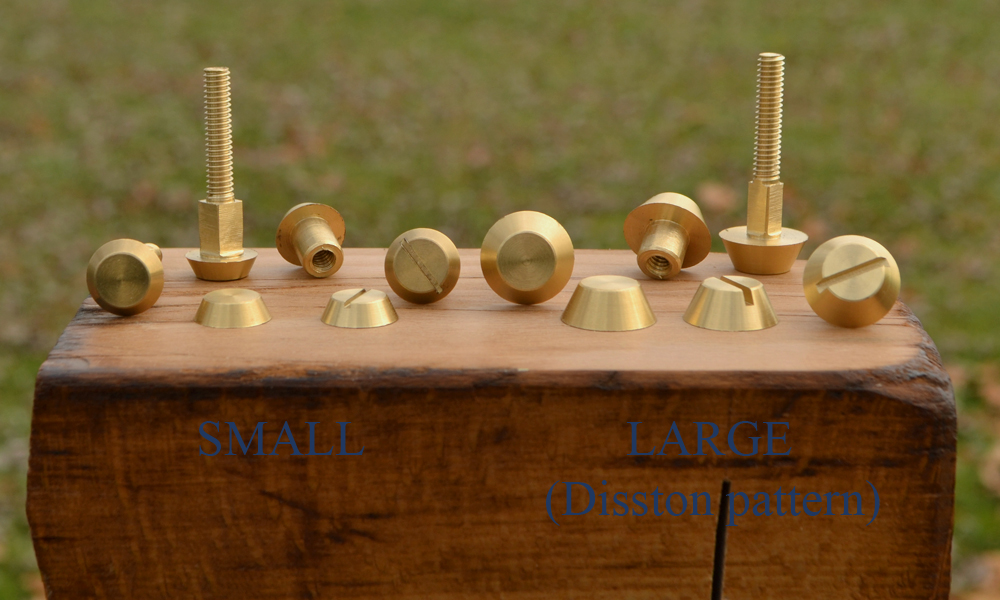
After multiple requests, I am now making truncated cone saw bolts and nuts. They are available in two sizes.

The large variant is intended to replace those found on several Disston models from the mid 19th century.  Their overall geometry is very similar to the originals, but as these are made on a lathe (not cast like the originals), there are some differences.

The small variant is a scaled down version of the large, and is intended for use on smaller backsaws or anywhere a lower profile is desired.

Full details and specifications are available on the order page. Depending on the response, there may be a delay of a week or two in getting orders out.

Small and large nuts and bolts.

Small and large nuts and bolts.

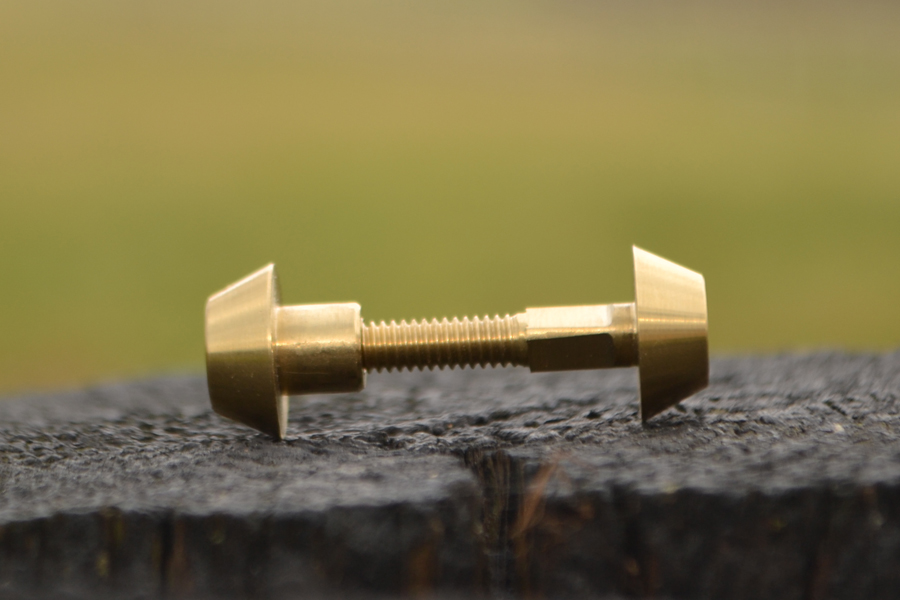
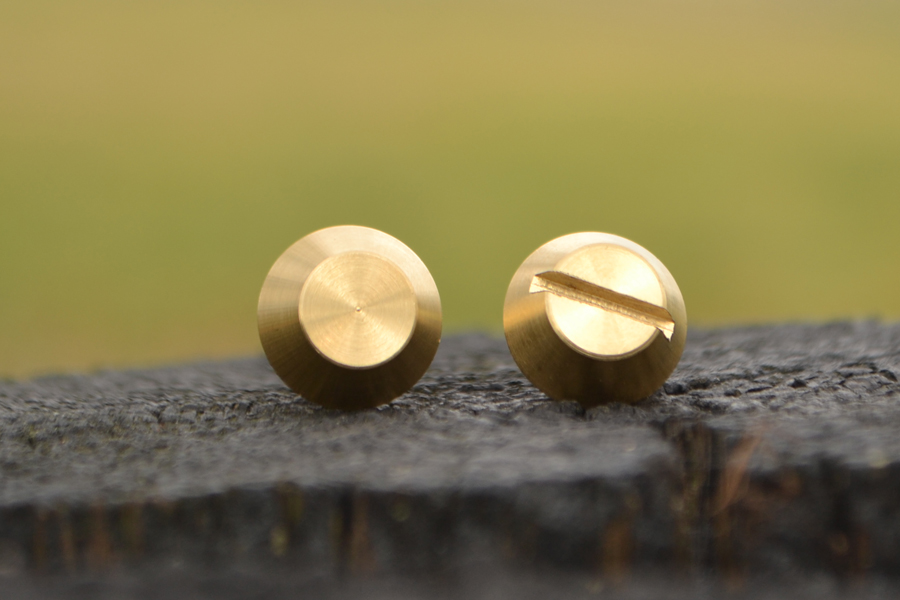
Large nut and bolt.

Large nut and bolt.

Large nut and bolt.

Large nut and bolt.


Edited to add:  The truncated cone nuts and bolts will be available as on option on all of my backsaws going forward. It will take me a few days to update the website; until then, they can be requested in a note at checkout.

Posted in Announcements | 2 Comments

Nothing Gold Can Stay

The three saws shown in my last post are all wrapped up and working their way across the big pond. Working with stainless steel presented some new challenges, but it’s hard to dwell on those when the last thought and image in my mind is of the striking family they make. It was with no small regret that I sent them on their way to their new abode.

The freshly minted Autumn classic trio, sporting walnut crotch and stainless steel.

The freshly minted Autumn classic trio, sporting walnut crotch and stainless steel.

Ten inch dovetail saw. Walnut crotch with stainless steel back.

Ten inch dovetail saw. Walnut crotch with stainless steel back.

Smith's Key twelve inch carcase saw. Walnut crotch with stainless steel back.

Smith’s Key twelve inch carcase saw. Walnut crotch with stainless steel back.

Smith's Key twelve inch carcase saw. Walnut crotch with stainless steel back.

Smith’s Key twelve inch carcase saw. Walnut crotch with stainless steel back.

Smith's Key twelve inch carcase saw. Walnut crotch with stainless steel back.

Smith’s Key twelve inch carcase saw. Walnut crotch with stainless steel back.

Fourteen inch sash saw. Walnut crotch with stainless steel back.

Fourteen inch sash saw. Walnut crotch with stainless steel back.


Nothing Gold Can Stay

Nature’s first green is gold,
Her hardest hue to hold.
Her early leaf’s a flower;
But only so an hour.
Then leaf subsides to leaf.
So Eden sank to grief,
So dawn goes down to day.
Nothing gold can stay.

Robert Frost, 1923

Posted in Completed saws - gratuitous pictures | 4 Comments

A trio of saws in the works

They don’t yet look like much, but this matching set should be something special. They are destined to live in England, with a gentleman whom I have had the pleasure of conversing with extensively.

The handles are walnut crotch, while the backs are stainless steel. The stainless steel is challenging to mill, and I have had more than a few failures along the way. I hope to offer it as an option on most or all of my saws in the near future, but need more practice milling it before committing fully.

Top to bottom: Fourteen inch sash saw, twelve inch Smith's Key carcase saw, and ten inch dovetail saw.

Top to bottom: Fourteen inch sash saw, twelve inch Smith’s Key carcase saw, and ten inch dovetail saw.


Posted in Saw making | 2 Comments

Finally on the Moxon vise bandwagon

Last month, with the Woodworking in America conference fast approaching, I finished my mini Roubo. While the diminutive size and knockdown construction make it a wonderful traveling bench, it does not incorporate any vises or clamps.

While not being one to rush into a trend, I have nevertheless long been intrigued by Moxon vises that others had built, and latched onto this vise as an inexpensive (and fast to make) workholding option. I scrounged up a lovely bit of quartersawn sycamore, some 3/4-6 Acme rod, a few nuts, and a couple of washers and bearings, and came up with this small model.

The construction of these vises being very straightforward, there is little need to chronicle it here. The only feature that may be considered somewhat unique is the handles, which have captive nuts let into them. Since the threaded rod is fixed to the rear chop, the handles are bored out so as to cover the rod projecting from the front.

I had some concern about being able to tighten the vise enough to grip the workpiece solidly, but this turned out to be a needless worry. Between the leather-lined front jaw and oversize handles, this vise holds its work like the dickens.

With one nut buried in the rear jaw, and another on the back of it, the threaded rod is fixed in place. Have I ever mentioned that I love a nice lamb's tongue detail?

With one nut buried in the rear jaw, and another on the back of it, the threaded rod is fixed in place. Have I ever mentioned that I love a nice lamb’s tongue detail?

Rear view.

Rear view.

The front chop rides on a bushing, while the large washer provides a bearing and (more importantly) wear surface between the handle and front chop.

The front chop rides on a bushing, while the large washer provides a bearing and (more importantly) wear surface between the handle and front chop.

Elongated holes in the front jaw allow it to accommodate skewed work.

Elongated holes in the front jaw allow it to accommodate skewed work.

I don't know when I last tried to clamp a skewed workpiece, but if the need ever arises I shall be ready.

I don’t know when I last tried to clamp a skewed workpiece, but if the need ever arises I shall be ready.

Without the washer, I fear the handle would quickly erode the front jaw.

Without the washer, I fear the handle would quickly erode the front jaw.

The jaws open to about three inches.

The jaws open to about three inches.

The handles are hollowed out to accept the Acme rod; the nuts are mortised into the end.

The handles are hollowed out to accept the Acme rod; the nuts are mortised into the end.

The front view.

The front view.

The only change I may make to the vise is adding a cleat at the rear to reduce any tendency to rock backwards.

The only change I may make to the vise is adding a cleat at the rear to reduce any tendency to rock backwards.

Yet another view.

Yet another view.

No reason for this picture, other than showing off some nicely figured wood.

No reason for this picture, other than showing off some nicely figured wood.

The vise in use. I am testing a saw on a scrap of wood that came from the same piece as the handle, which seems oddly...cannibalistic.

The vise in use. I am testing a saw on a scrap of wood that came from the same piece as the handle, which seems oddly…cannibalistic.

Posted in Around the shop | 1 Comment

Catching up on walnut crotch handles

For all of you who have saws with walnut crotch handles on order, this should be welcome news. After a lot of sawmill tours, phone calls, and online searches, I finally have enough walnut crotch to make a sizable dent in the backorders.

Having finally caught up with most of the aftermath of WIA, I spread out my growing stash of wood to cut out some handle blanks. While I enjoy this first glimpse of what is to come, there is some trepidation. This wood comes dearly, and due to the nature of the grain, is difficult to dry without cracking and checking. While the wood may be sound on the surface, I have lost a few blanks to internal cracks and hidden bark pockets.

When planning my cuts, I try to maximize and balance yield, figure, and strength. I usually end up cutting a six inch wide strip (the width of my planer) that captures most of the figure in the crotch. Even on a large slab, the best figure may only yield two or three handles; a slab that yields four blanks is exceptional.

I never tire of seeing the beautiful colors and patterns in this wood.

I never tire of seeing the beautiful colors and patterns in this wood.


In addition to the wood shown in the picture above, I have several larger slabs to cut. I often wonder what the sawyers think of me buying a large slab, only to cut it into small pieces. I do have an occasional twinge of guilt over cutting into such pieces, but it goes away when I remember that it will end up in the hands of those who will most appreciate it.

Posted in Saw making, Wood | Leave a comment